| OCR Text |
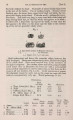
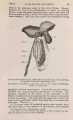
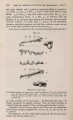
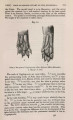
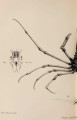
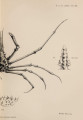
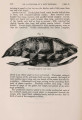
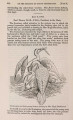
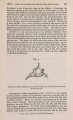
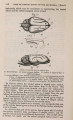
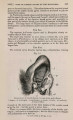
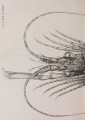
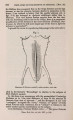
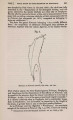
Show 340 MR. E. J. MIERS ON [Mar. 21, 2 are placed on the cardiac region, of which the posterior is very large, 3 (very large) on the intestinal region, 2 on each hepatic region, and about 7 on each branchial region, besides tbe marginal spines, of which there are 5 ; 3 are placed on each pterygostomian region, the anterior of which is situated at the antero-lateral angle of the buccal cavity ; there is also a distinct but not very large prse-ocular spine. The orbits are rather small, with a lateral aspect, and with two fissures above and a large hiatus below. The spines of the rostrum are subcylindrical and very long (in the male as long as the carapace), straight, and very slightly divergent distally ; they bear an accessory spine on their upper surface at some distance from the distal end, which is acute. The basal antennal joint is longer than broad, and bears a strong spine, directed obliquely downward, at its antero-external angle ; the next joint is slender and very much elongated, the third also slender; these joints and the flagellum are scarcely visible in a dorsal view. The epistoma is large, but broader than long; the ischium joint of the outer maxillipedes is longer than broad; the merus joint truncated at its distal end, and with only a very small notch at its antero-internal angle above the place of articulation with the next joint. The chelipedes in both sexes are slender ; in the male, however, somewhat more robust than in the female; the merus joint is cylindrical, elongated, with a strong spine above at its distal end. Carpus short, armed on its upper and outer surface with two or three small spines or tubercles ; palm smooth, subcylindrical (in the male about 3| times as long as broad) ; fingers slender, more than half as long as the palm, somewhat incurved, having between them when closed (in the male) a small hiatus at base; both fingers in their distal halves are denticulated and meet along their inner edges ; the mobile finger has in the male a tubercle on its inner margin near the base. The ambulatory legs are slender and much elongated, the first pair very much longer than the following; there is a spine at the distal end of the upper surface of the merus joints in all the ambulatory legs. The dactyli, although shorter than the preceding joints, are yet elongated and slightly curved, and terminate in a small corneous claw. The segments of the postabdomen are all of them distinct in both sexes; in the male all, except the last, have a small median spine, on each side of which, on the second and third segments, is a lateral spine; in the female the first four are armed with a small median spine or tubercle. The animal is covered with a short dense yellowish-brown pubescence, which, however, is absent from the palms and fingers of the chelipedes, and partially so from the penultimate and terminal joints of the ambulatory legs, the ground-colour of the integument being, in these places, in the two dried specimens I have examined, purplish-red. Length of the carapace to the base of rostral spines in an adult male about 2§ inches (68 mm.), which is also the length of tbe spines themselves; of a chelipede about 4| inches (113 m m . ) , of the first ambulatory legs nearly 9| inches (242 mm.). Two specimens, a male and a female, were collected. In the female the carapace is somewhat more pyriform and convex, the |