| OCR Text |
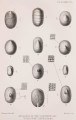
Show 1882.] MR. H. J. ELWES ON BUTTERFLIES FROM SIKKIM. 403 soni, Moore, and resembles the former very closely above, but not below. The males have a more purple tinge on both wings than I hewitsoni, but the females are hardly, if at all, to be distinguished from this species, which I have taken at Darjeeling in December. The genus is a very difficult one, as there are four or five very nearly allied species in the Himalaya. VANESSA LADAKENSIS, Moore, Yarkand Mission, Lep. p. 3, t. i. fig. 2(1879). About fifteen specimens, mostly worn, of this species, all of which agree in their characters, and can be known at once from the forms of V. urticce by the shape of the fore wings, which are rounded at the apex, with hardly a trace of the projecting point below the angle which is conspicuous in V. urtica, V. kashmeriensis, and V.polychloros. It seems to be an inhabitant of the high cold plateau of Tibet, was first taken at Gogra in Ladak, and has never been sent to England from Sikkim, to m y knowledge, before ; so I think we may conclude that it does not occur on this side of the passes. VANESSA KASHMERIENSIS, Koll. Kasch. p. 442, t. ii. Some of the specimens of this species are very near V. rizana of Moore, which seems to me hardly separable from it. Sikkim specimens, as a rule, are darker than those from Kashmir. It occurs at and below Darjeeling during winter, and I have taken it on sunny December days at 4000 feet. VANESSA C-ALBUM, Linn. A single, rather worn specimen was included in the collection, which, until we know more of the Himalayan varieties, I prefer to call V. c-album. It is certainly much nearer to Amur specimens of V. c-album than to what I have from Mr. Moore as typical V. agnicula. I have only seen one specimen from Sikkim before, which differed from this one ; and four others which I possess from various parts of the Himalaya differ from each other as much as a similar number of European specimens from various localities do. Unfortunately, I have but fifty specimens in all of this group-not a tithe of what would be required to illustrate it properly; but the more I see, the more impossible it seems to define them clearly. I should be much obliged to any entomologist for the loan of local series showing the amount of variation in different localities; but, so far as I can see at present, no one can say to what species a given specimen of any of these forms belongs, unless he was told where it came from; and if that be so, what more is necessary to prove my theory ? ARGYNNIS ALTISSIMA, n. sp. (Plate XXV. fig. 8.) Of this species I received ten specimens, all of which, as well as I can judge in the somewhat crushed state of their bodies, are males. Nine of them agree very well in size and pattern ; but the tenth is at least a quarter larger in size, and has the wings broader and less pointed. In fact it has the appearance of a less alpine variety than |