| OCR Text |
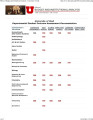
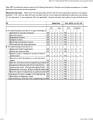
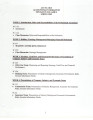
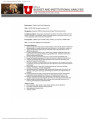
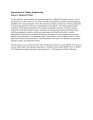
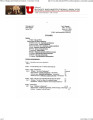
Show Department of Mining Engineering Senior Capstone Project In Fall semester, senior students are required to enroll in a Mineral Evaluation course. One of the objectives of this course is to develop a drillhole data base that includes grade and geologic conditions for a mineral deposit. From this data base, students construct an ore body model that is used Spring semester to develop a mining plan for the deposit. The mining plan includes evaluation of the market potential for the mineral commodity, selection of the best mining method to extract the mineral resource, resolution of engineering problems and design issues including equipment selection, workforce requirements and health and safety concerns, assessment of the economic potential of the mine, evaluation of environmental and economic impacts, and formulation of a reclamation plan. Each student or team prepares a final written report and a formal oral presentation. Oral presentations are made to an audience composed of students, faculty, and interested visitors. The following course outlines describe both the Mineral Evaluation course MGEN 5340 and two courses which satisfy the capstone requirement. Students choose either MGEN 5090 or MGEN 5120 depending on their particular career interests (i.e., Underground or Surface Mining). THE UNIVERSITY ° F UTAH COLLEGE OF MINES AND EARTH SCIENCES DEPARTMENT OF MINING ENGINEERING MG EN 5340 Mineral Evaluation Fall 2005 Description: Ore reserve estimation and grade control under conditions of selective mining Prerequisites: MATH 3070 or MET E 3070; MG EN 5020 recommended Credit Hours: 2 Class Time: T, H 9:10 AM - 10:30 AM; WBB 108 Coordinator: James Donovan, Assistant Professor of Mining Engineering WBB 317 585-3029 jame s.donovan@mines.utah.edu Objectives: The class is designed to introduce mining engineering students to the principles and applications of mineral project evaluation. Upon completion of the course students will: • Be able to specify the various standards of resource/reserve definition and discern the differences among them. • Understand and utilize techniques for orebody modeling and grade assignment. • Be able to apply the principles of geostatistics for reserve estimation. • Be acquainted with mine planning software packages. • Be knowledgeable of the components of a pre-feasibility study. • Have selected a mineral property for detailed evaluation. • Have developed a pre-feasibility study for a mineral property. • Have compiled and written a pre-feasibility report. • Have communicated the pre-feasibility findings in an oral presentation. Content: The following is a general outline of the topics to be covered. 1. Resource and reserve standards, reporting, and examples 2. Components of a pre-feasibility study 3. Orebody modeling; method of sections, triangles, polygons, and block models 4. Geostatistics 5. Overview and application of mine planning software 6. Pre-feasibility report writing and presentation MG EN 5340 Fall 2005 Evaluation: Homework will be assigned on a weekly basis in order to assess the student's comprehension of the various components of mineral evaluation (i.e., orebody modeling, geostatistics, etc.). One exam (mid-term) will be given in order to evaluate the student's grasp of mineral evaluation fundamentals. A major feature of this course is the preparation and presentation of a pre-feasibility study for an actual mineral deposit. A final project that includes both a written report and oral presentation of the study will be used to appraise the student's overall ability to properly describe and evaluate a mineral deposit in a qualitative and quantitative way. Grading: Homework 45% Exam 20% Project 35% Materials: References: SMEMining Engineering Handbook. H. Hartman, ed. SME, 1992. Vol. 1, Sections 5 - 8. Website: A website has been developed to aid in the management of this class. To access the website students can log-in to WebCT at https://webct.utah.edu using their uNID and password. Accommodations: The University of Utah seeks to provide equal access to its programs, services and activities for people with disabilities. If a student will need accommodations in the class, reasonable prior notice needs to be given to the Center for Disability Services, 162 Union Building, 581-5020 (V/TDD). CDS will work with the student and the instructor to make arrangements and accommodations. Responsibilities: Both the instructor and student are expected to maintain and enforce responsible classroom activities and behavior. Students are responsible for knowing their classroom rights and responsibilities as denoted in the Student Code (www.admin.utah.edu/ppmanual/8/8-10.html). The instructor is obligated to preserve the classroom environment according to the Faculty Rules and Regulations. MG EN 5340 Fall 2005 CLASS SCHEDULE Note: This timeline is only approximate. DATE TOPIC Th Aug 25 Course introduction T Aug 30 Assessment and valuation of mineral assets Th Sept 1 Assessment and valuation of mineral assets T Sept 6 Assessment and valuation of mineral assets Th Sept 8 Assessment and valuation of mineral assets T Sept 13 Valuation case study Th Sept 15 Valuation case study T Sept 20 Feasibility studies Th Sept 22 Feasibility studies T Sept 27 Resource estimation - Sections Th Sept 29 Resource estimation - Sections T Oct 4 Resource estimation - Polygons Th Oct 6 Fall Break - No Class T Oct 11 Resource estimation - Block Models Th Oct 13 Resource estimation - Block Models T Oct 18 Geostatistics EXAM Th Oct 20 (take home) T Oct 25 Geostatistics Th Oct 27 Geostatistics T Nov 1 Mineral evaluation/planning software Th Nov 3 Mineral evaluation/planning software T Nov 8 Mineral evaluation/planning software Th Nov 10 Mineral evaluation/planning software T Nov 15 Mineral evaluation/planning software Th Nov 17 Mineral evaluation/planning software T Nov 22 Pre-feasibility preparation Th Nov 24 Thanksgiving - No Class T Nov 29 Pre-feasibility preparation Th Dec 1 Pre-feasibility preparation T Dec 6 Presentation of pre-feasibility studies Th Dec 8 Presentation of pre-feasibility studies Dec 13 Pre-feasibility report DUE MG EN 5340 Fall 2005 MINING ENGINEERING 5090 - UNDERGROUND MINE DESIGN Spring Semester 2005 - Syllabus Instructor: Mike Nelson, Associate Professor of Mining Engineering - Phone: 585-3064 (office) 455-6217 (mobile) Office Hours: Monday and Wednesday, 9:40 - 10:30 a.m, and by appointment Office: 316 Browning email: mgnelson@mines.utah.edu OBJECTIVES: 1. Apply the knowledge of mathematics, science, and engineering (as gained in previous undergraduate study) to the design of an underground mine. 2. Prepare a project plan and project schedule for complete design of an underground mine, starting with basic geologic data. Follow the schedule to complete the following objectives. 3. Analyze exploration data to estimate reserves, in situ grade, as-mined grade, for selected mineral deposits. 4. Use mine design and simulation software to conduct experiments that will determine optimum mining method, mine plan, and production schedule for selected mineral deposits. 5. Design, specify, and select equipment for an underground mine 6. Complete the design of ventilation, materials handling, and power utilities systems for an underground mine, using standard engineering procedures 7. Analyze the effects of an underground mine on the surrounding environment, considering both natural ecosystems and human socio-economic systems. 8. Prepare a presentation-quality report describing the completed mine design, including text, maps, technical drawings, permit applications, and all other pertinent documents. 9. Present the completed mine design to an audience of faculty and peers, showing good speaking skills and using effective visual aids, including overhead transparencies, computer graphics or others as appropriate TEXTBOOK: Hartman, H. L., SME Mining Engineering Handbook, 2n d Edition, SME, Inc., Littleton, CO, 1992 REFERECNCES: 1. Peng, S. S., and H. S. Chang, Longwall Mining, John Wiley & Sons, New York, 1984 2. Peng, S. S., Coal Mine Ground Control, John Wiley & Sons, New York, 1978 3. Williams, W. R., Mine Mapping and Layout, Prentice-Hall, Englewood Cliffs, New Jersey, 1984 4. Cassidy, S. M., Elements of Practical Coal Mining, SME-AIME< New York, 1973 5 Anon, Code of Federal Regulations, 30, Mineral Resources, Office of the Federal Register, National Archives and Records Service, General Services Administration: For sale by the Supt. of Docs, U.S. G.P.O., Washington, D. C GRADING: Project Schedule 5% Feasibility Study and Proposal 5% Staying on Schedule 20% Final Report 70% Week Month Date Topic Covered Suggested Schedule 1 January 7 Using Microsoft Project 12 Last day to drop (delete) classes 16 Last day to drop classes 2 14 Feasibility Studies/Cost Estimates Project Schedule 3 21 Martin Luther King Day 23 Mapping and Geological Anomalies Surface and Geological Maps 4 28 Initial Equipment Selection Initial Equipment List February 1 Feasibility Study and Proposal 9 March 4 Mine Layout and Area Definition Initial Layout and Mine Plan 10 11 Mine Sequence Analysis Haulage Schedule and Layout 15 Last day to withdraw from classes 11 18 Ventilation Ventilation Plan 12 25 Roof Control Roof Control Plan 13 April 1 Mine Water and Utilities Power and Utilities Specs 14 8 Safety Review Safety Compliance Report 15 15 Final Equipment Selection Final Equipment List 16 22 Final Layout and Specification Final Layout and Specs 17 29 Final Cost Analysis and NPV Prepare Presentations 18 May 2 Project Presentations Final Report MG En 5090 Underground Mine Design Syllabus, Spring 2005 Instructor: M. G. Nelson Associate Professor of Mining Engineering Office Hours: Thursday, 10:45 - 12:00 noon Text: Hartman, H. L., SME Mining Engineering Handbook, 2n d Edition, SME, Inc., Littleton, CO Week Date Day Lecture Lab 1 1/10 M Engineering Feasibility Studies 1/12 W Microsoft Project 2 1/17 M MLK Day 1/19 W Project Schedule Last Day to drop classes 3 1/24 M Equipment Cost Estimates Initial Reserve Analysis Last Day to add classes 1/26 W Preliminary Equipment List 4 1/31 M Mine Maps and Grids 2/2 W Initial Mine Layout 5 2/7 M Mine Layout 2/9 W Haulage Layout 6 2/14 M Block Modelling 2/16 W Block Models 7 2/21 M Presidents' Day Major Equipment Specification 2/23 W Block Models 8 2/28 M SME 3/2 W SME % F Last Day to withdraw from class 9 3/7 M Ventilation Major Equipment Specification 3/9 W Ventilation Plans 10 3/14 M Spring Break 3/16 W Spring Break 11 3/21 M Roof Control Roof Control Plans 3/23 W Mine Plan 12 3/28 M Mine Power Systems Mine Plan 3/30 W Mine Power System Layout 3/31 H Seminar Presentation 13 4/4 M Block Sequencing 4/6 W Block Sequencing 4/7 H Seminar Presentation 14 4/11 M Block Sequencing 4/13 Financial Analysis 15 4/18 M Financial Analysis 4/20 W Sensitivity Analysis 16 4/25 M Presentation Preparation 4/27 W Mini-Symposium Presentations Made 4/28 H Reading Day The products of this class will be the Mine Design Reports, which will be printed, bound, and shelved in the department library. Oral presentations of the reports will be made near the end of the semester. Attendance at classes and labs is mandatory, because the reports will be prepared in those meetings. Students will work in groups, with the various sections of each report being prepared by assigned group members. The sections of each report will be reviewed by the class, and by the instructor, before being revised for the final report. Grades: Pre-feasibility analysis: 10% Design report, rough draft: 20% Final design report: 30% Oral Presentation: 30% Staying on Schedule: 10% Surface Mine Design - MG EN 5120 -1 and 2 Spring Semester 2005 Instructor: M. K. McCarter Credits: 3 Semester Hours Lecture: Monday 12:55 - 1:45 - Room 108 WBB Laboratory: M,W 2:00 p.m. to 5:00 - WBB 108 Textbooks: 1. Open Pit Mine Planning and Design (OPP), Hustrulid, W. And Kuchta, M. Vol. 1 and 2, A. A. Balkema, 1995 2. SME Handbook (HB) 2 n d Ed. Hartman, H. L., Senior Editor, SME - AIME, 1992 3. Surface Mining (SM), 2 n d Ed., Kennedy, B. L., Editor, SME-AIME, 1990 References: 1. Mining Cost Service, Western Mine Engineering, Inc., Spokane, WA 1996 2. Sherpa and Apex Manuals, Western Mine Engineering, Inc. 1996 3. Caterpillar Performance Handbook, Caterpillar Tractor Co., Peoria, IL 1999. Grading: 1. Partial Products - 60% 2. Final Report - 30% 3. Final Presentation - 10% Drop/Withdraw Substitute Day: 1. Last day to drop (delete) classes: Wednesday, January 17th 2. Last day to withdraw from classes with no tuition penalty: Wednesday, Jan 17th 3. Last day to withdraw from classes: Friday, March 2 n d Note: The following lecture and laboratory schedules are a first approximation due to the change to the Vulcan software. Laboratory Schedule Lab Date Topic 1 Jan. 8 CS Mine Tutorial for Cu 2 Jan 10 CS Mine Applied to the Gold Property, Use Costs from SME, Price Prediction, First Estimate Reserve Calculation 3 Jan 15 Martin Luther King Day - Holiday 4 Jan 17 Initial Bench Height, Equipment and Metallurgy Selection from Literature 5 Jan 22 Appliation of the Utah Computer Program - Reserve Estimation with Sections 6 Jan 24 Continuation of Reserve Estimation, Report Preparation 7 Jan 29 Creation of a Mineral Block Model 8 Jan 31 Alternative Mineral Block Models 9 Feb 5 Report Preparation - Mineral Inventory 10 Feb 7 Development of Initial Capital/Operating Costs 11 Feb 12 Development of an Economic Block Model 12 Feb 14 Report Preparation - Economics/Economic Block Model 13 Feb 19 Presidents' Day Holiday 14 Feb 21 Pit Slopes Analysis 15 Feb 26 Ore Reserve Using Whittle 16 Feb 28 Ore Reserve/Tonnage-Grade Curves 17 Mar 5 Report Preparation - Ore Reserves 18 Mar 6 Pit Smoothing - AutoCad 19 Mar 12 Spring Break 20 Mar 14 Spring Break 21 Mar 19 Pit Smoothing - AutoCad 22 Mar 21 Addition of a Haul Road 23 Mar 26 Reserve Re-Calculation Including Road 24 Mar 28 Report Preparation - Final Pit 25 Apr 2 Development of Phase Plans 26 Apr 4 Yearly Production Schedule 27 Apr 9 Location of Dumps, Tailings Ponds, Facilities Report Preparation - Schedule 28 Apr 10 Calculation of Revised Operating Costs, Capital Costs, Revenues 29 Apr 16 Calculation of Cash Flows ROI, etc. 30 Apr. 18 Final Report Preparation 31 Apr 23 Final Report Preparation 32 Apr 25 Final Presentations |