| OCR Text |
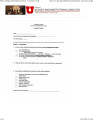
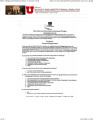
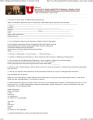
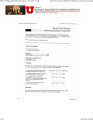
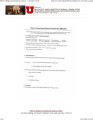
Show Office of Budget and Institutional Analysis - University of Utah http://www.obia.utah.edu/2006Accred/soa/capstone_courses/lal_cap.php The Capstone in French I. Goals of the Capstone The capstone in French is considered the culminating point of the French major. It gives you the opportunity to demonstrate the skills you have accumulated over the course of your French major. For the capstone, you will perfect a written paper of particular interest to you in the field of French and Francophone studies and exchange ideas about the paper with several French faculty members. The capstone also gives you a chance to link together various aspects of your French coursework. < http://www.hum.utah.edu/languages/french/acaprogs/capstone.htm#top> I I . Preparing for the Capstone Register for French 4990: Capstone Course (one credit) for the last semester of your French major. You will need a permission code available from the undergraduate secretary in 1400 LNCO. Select a paper written for a 4000-level course that focuses on literary and/or cultural interpretation of texts written in French. You will rework the paper to further your analysis and to improve your language, style, and organization. A well written paper will propose an analytic thesis and develop an argument in good French based on close textual readings. The paper may use secondary sources, but they should not be the focus of the paper. During the first month of the semester, meet with the professor with whom you wrote the paper and discuss how you will rewrite it. You will be expected to do one or two more drafts of your work. Your final version should be 5-10 printed pages in length (standard margins and font). If you are writing an honor's thesis with a French professor, it can serve as your capstone paper. To prepare for the capstone discussion, think in depth about how your paper and the ideas you present relate to other aspects of French studies, particularly other time periods, other types of texts, other cultures you have studied, and other disciplines with which you are familiar. Look at other texts you have read during your major that treat similar ideas and be prepared to talk about the similarities and differences you find in concrete and general terms. Meet with your faculty mentor and discuss your ideas. When you and your faculty mentor are both satisfied with the paper, submit six copies to the undergraduate secretary in 1400 LNCO, at least one week before the capstone date (date available from the undergraduate advisor, usually the last week of class in December and April). < http://www.hum.utah.edu/languages/french/acaprogs/capstone.htm#top> I I I . The Capstone Discussion The capstone discussion will be attended by three or more faculty members. It is intended to be a sharing of ideas and an intellectual discussion, not a stressful exam. You will begin the discussion with a brief presentation of the paper. The presentation will explain why and how the paper was chosen, why it represents the best work of the major, and what you might do to make the paper even better. Professors will then ask you questions directly related to your paper and to your argument. In the second section of the discussion, you will be asked how your paper topic relates to other literary or cultural texts you have studied from the same or different time periods or from other cultures you are familiar with. The discussion will last approximately thirty minutes and will be in French. The Capstone in German In the German section capstone courses are required of all majors ( GERM 4990 for 1 semester hour) and are usually attached during the last semester of the student's major studies to a German course on the 4000-level. These capstone courses measure--as a norm in form of an extended research paper under the close guidance and upervision of and in frequent consultation with a chosen instructor--what knowledge and theoretical tools the student has acquired in the subject area and what s/he has learned in terms of doing research, evaluating the latter and then presenting it in a cogent, articulate and lucid manner. 1 of 2 10/13/2006 2:22 PM Office of Budget and Institutional Analysis - University of Utah http://www.obia.utah.edu/2006Accred/soa/capstone_courses/lal_cap.php The Capstone in Japanese In the course, students are required to write a short research paper on a topic either in Japanese literature or language/linguistics. The topic has to be mutually agreed upon between the student and the instructor. the length of the paper is approximately between 10 and 15 pages, preferably in Japanese. The course is to be taken during student's last semester in the program. The Capstone in Russian RUSS 4990 (Capstone) must be taken during the final semester of study in the Russian B.A. program. The Russian Capstone consists of a series of exams based on the student's coursework. It is the student's responsibility to sign up for the capstone (see advisor). During the first two weeks of the final semester the student must supply the Russian advisor with a list of all courses taken to fulfill Russian major requirements. This list should consist of the following information for each course: Course number, Course title, Year and Semester taken, and instructor's name. Exams will be composed based on this information. THE CAPSTONE WILL CONSIST OF FOUR EXAMS 1. Russian usage: Grammar, listening, writing, reading (Plus the following electives: Reading the Russian Press, Business Russian, 4550 Russian Culture) 2. Linguistics: RUSS 4270 and 4271 (Plus any electives offered by Dr. Hacking) 3. Pre-1900 Literature and Culture: RUSS 3550 and 4710 (Plus the following electives: Russian through Poetry and Classical Russian Literature on Film) 4. Post 1900 Literature and Culture: RUSS 3560 and 4720 (Plus the following electives: Post-Fall Russia, Russian through Music) The Capstone in Spanish In Spanish there is not one syllabus for the section; each professor assigns his/her own capstone project, one related to the course that the student is taking with this faculty member. Included here is Prof. Morrow's syllabus from fall 2004 in Spanish, with an English translation provided. Office of Budget & Institutional Analysis (OBIA) 110 Park Building, 201 South President's Circle, Salt Lake City, UT 84112 Office: 801-581-6948 | Fax: 801-581-7541 | Email: info@obia.utah.edu The University of Utah © - Disclaimer 2 of 2 10/13/2006 2:22 PM |