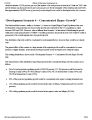
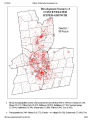
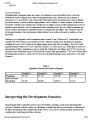
| OCR Text |
Show Technology and Urban Form Predicting the types of future innovations and their social outcomes is fraught with uncertainty. Technological breakthroughs in genetics, robotics, information technology and nanotechnology will likely alter our future world in ways that are usually imagined by writers of science fiction. [11] There are, however, several recent technological trends related specifically to digital technology that are worth considering because they are already beginning to influence the spatial pattern of land development in the U.S. Historically, technological innovations have been inseparable from the process of urbanization. The industrial revolution in the 19th and 20th centuries proceeded in a dialectical relationship with the process of urbanization characteristic of these same periods. New manufacturing and building processes, for example, both enabled and inspired mass urbanization on an unprecedented scale. Fast transportation; from the railroads in the 19th century to the automobiles of the 20th century, have enabled long-distance traveling and commuting. In addition, the evolution of mass media, particularly television, has played an important role in influencing people's patterns of consumption and shaping feelings and choices on how and where people want to live. Computers, and digital technology in general, are now central to the present and near-future phase of urbanization, though the influence of this technology on regional settlement patterns is only beginning to be realized. Urbanist Lewis Mumford noted some of the potential influence of recent technologies as long ago as 1960 when he wrote that metropolitan over-congestion, for example, is unnecessary since the change in the mode of human settlement brought about by fast transportation and instantaneous communication means that physical congestion is no longer the sole possible way of bringing a large population into intimate contact and cooperation. [12] This observation has even more practicality now that more and more of the U.S. workforce is shifting toward occupations that manipulate digital data, while at the same time the Internet has enabled instantaneous digital communication, which means that an actual physical office presence for many employees is unnecessary to carry out many workday functions. While the full potential of "telecommuting" hasn't nearly been realized - according to the 2000 census only 3% of the U.S. workforce telecommutes - the potential for telecommuting to provide a low- to no-cost means of reducing metropolitan traffic congestion offers great promise. In addition, telecommuting may increase productivity. A survey of American Express telecommuters found that they produced 43 percent more business than regular office workers. In addition, telecommuters save companies in real estate costs by reducing the need for office space. For example AT&T telecommuters save the company approximately $25 million per year. And as states and localities are finding it increasingly difficult to maintain and expand highways under the status quo commuter model, people are likely to have little choice but to embrace telecommuting on a much broader basis in the future. While digital communication allows the "dematerialization" of the workforce, enabling data-manipulators to work wherever they have an Internet hookup, digital communication has also enabled employers a much greater freedom to locate wherever labor and regulatory costs are cheapest (what geographer David Harvey calls a "spatial fix"), which have turned out to be mostly outside the boundaries of the U.S. The effects of this trend can be observed regionally in the many vacant and underutilized industrial sites in cities such as Schenectady, Cohoes, Watervliet, Mechanicville and Amsterdam. 1/7/2010 Effects of Alternative Development Sc… cdtcmpo.org/policy/june07/wa-doc.htm 43/60 |