| OCR Text |
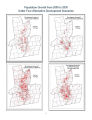
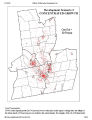
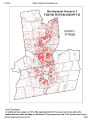
Show with short-term life cycles and commercially standardized designs. Much of the job activity will be located in industrial/office parks scattered throughout the region. Many senior citizens, who will become an increasingly large percentage of the total population, will likely downsize their single-family suburban homes for segregated senior housing, rather than relocate to the region's cities, which will be viewed as dangerous and crime-ridden. The overall development pattern described above will require most people to own and use a car to go about their daily business. The spread-out pattern of development will make mass-transit services impractical for much of the population. This auto-dependence will lead to a dysfunctional transportation system, where highway gridlock and extended peak hour(s) daily traffic congestion become the norm. The demand for highway/road building and maintenance will most likely outstrip the public's ability to fund these improvements. Regional natural resources and working landscapes will be degraded by the nearly 150,000 acres of land consumption. Prime farmland will be lost to subdivisions. There will be increasing pressure to develop environmentally sensitive lands that may impact water quality and increase downstream flooding due to the additional impervious surfaces. With the developed land area of the region nearly doubling, the overall character of the region will change dramatically. Many areas that are currently rural will be developed creating the need to invest in new public infrastructure such as sewer, water and roads, and expanding municipal services such as police and fire protection, municipal planning, code enforcement, property assessment, and other services. Ninety-five percent of the population growth under Scenario 3 will occur outside the region's cities and villages. The cities of Albany, Schenectady and Troy would decline in population by a combined total of 2,226 persons, which would be a continuation of a trend that began in the late 1940's. Although the rate of urban decline will slow significantly compared to the past fifty years, the lack of overall population growth will also mean a general lack of tax resources to maintain city services. Sewer, water and road systems will fall into a state of major disrepair with more frequent breakdowns as maintenance and upgrades are continually deferred due to lack of municipal resources. State and federal subsidies will become more difficult to secure as cities compete for help with expanding suburban areas where most of the new growth is occurring (and where a majority of voters would now reside). The general abandonment of decaying and/or obsolete structures in cities will continue, and the abandonment of structures in the inner-ring suburbs will become more common place. Similar to today, but to a higher degree, the cities will continue to be the home of the majority of the region's poorest residents and residents needing social services. The cities will also continue to be the home for the region's minority residents, particularly blacks and Hispanics, which will make up the majority of theses cities populations. Although this will create opportunities for minority political power within these areas, this situation will most likely exacerbate regional political divisions between these cities and the outlying areas. 1/7/2010 Effects of Alternative Development Sc… cdtcmpo.org/policy/june07/wa-doc.htm 34/60 |