| OCR Text |
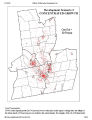
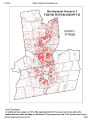
Show and if we assume that the remaining growth (53,795 persons) would occur at traditional suburban densities of 2 persons per acre, then approximately 26,898 acres of previously undeveloped land would be developed under this scenario versus 40,549 developed acres projected under the status quo trend. Moreover, if policies were implemented to achieve a modest increase in the development density - to 4 persons per acre - for half of the population growth that would occur outside the existing cities and villages (26,898 people), then an additional 6,724 acres of land could be saved from development, which, overall amounts to 20,375 acres of undeveloped land preserved compared to the status quo trend. "Development Scenario 3 - Trend Hyper-Growth" Using population projections for the United States to the year 2040, Capital Region Target Populations were developed for each projection year, which represented the application of the growth rates expected for the U.S. to the Region's 2000 Census population. The growth rates applied sequentially were: for 2000-2010, 9.50%; for 2010-2020, 8.70%; for 2020-2030, 8.27%; and for 2030-2040, 7.80%. Each TAZ was assigned to a classification from 1 to 4, where 1 represents highly developed urban areas (population density of 3000 persons or greater per sq. mile by census block group); 2 represents TAZ's within the existing census-designated "urbanized area" boundary (except those classified as 1); 3 represents TAZ's outside the urbanized area boundary but adjacent to TAZ's classified 3; and 4 represents the remaining rural areas. A number of TAZs in the #2 classification were identified which appeared to be fully developed, based on existing land use, and their average density was calculated as the average number of (2000 Census) persons per developable acre (i.e., land area less government-owed land and land undevelopable because of environmental constraints). The resulting average density, 2.84 persons per developable acre, was established as a development constraint for this scenario. Developable land within each TAZ was calculated based on the existing area of each TAZ minus environmental constraints areas. These constraints were determined by developing a composite map of the following: state regulated wetlands, 100-year flood zones, slopes greater than 15 percent, hydrography (streams, rivers, lakes, ponds, etc.), and public preserves and parks. Once this composite constraints map was created, these areas were removed from each TAZ. Using CDRPC's county-level population projections, the distribution of county population change as a percent of total Regional population change was derived for each projection year, and those distributions applied to the Regional Target Population changes to produce County target populations for each projection year. For each projection year, a factor was derived which, when applied equally to CDRPC's County TAZ projections for that projection year, yielded a TAZ sum equal to the County target population for that projection year. For any TAZ in any projection year, if the product of the County factor and CDRPC's projection exceeded the density constraint, the assigned population projection was determined to be the higher of 1) the original CDRPC projection or 2) the population implied by the density constraint (i.e., 2.84 × the TAZs developable area). 1/7/2010 Effects of Alternative Development Sc… cdtcmpo.org/policy/june07/wa-doc.htm 26/60 |