| OCR Text |
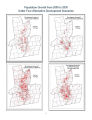
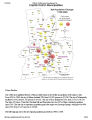
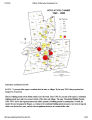
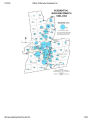
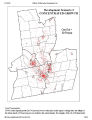
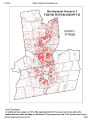
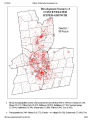
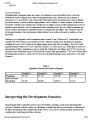
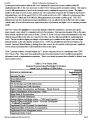
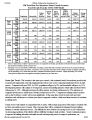
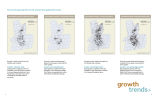
Show (58,553). Land Consumption Quantifying land consumption under this scenario is problematic because the method used to create this distribution involved scaling up areas where development already exists, without any caps in density, in proportion to U.S. growth rates. One of the results of this method is that in suburban areas where residential growth has already occurred in relatively high quantities, such as Delmar or Latham, densities would increase beyond the "suburban" type densities that currently exist. In addition, growth would be minimal and at very low densities in areas that have so far not experienced much residential growth. The rate of land consumption per person would be much harder to generalize in terms of "existing cities and villages" and "suburban" since the development densities of new development within suburban towns would not be nearly as uniform as it has historically. Therefore, as a rough guide to land consumption under Scenario 4, the "Urban Level 2" overall density was calculated for 2040. Urban Level 2 includes the TAZ's within the existing census urbanized area boundary, excluding the Level 1 TAZ's (which are the highest density areas in the cities and villages). The 2040 overall population density of the Level 2 TAZ's under this scenario is 2.93 persons per acre. If this figure is used as an approximation of land consumption per person outside the existing cities and villages, and 227,534 persons are projected to live outside these areas in 2040 under this scenario, then approximately 77,657 acres of land will be developed under Scenario 4, which is 69,518 acres less developed land than what is projected to occur under Scenario 3. Table 1 Population Growth and Land Development Scenario 1 Scenario 2 Scenario 3 Scenario 4 Population 90,538 90,538 309,190 309,190 Acres of Land Developed 40,549 26,898 146,855 77,657 Interpreting the Development Scenarios Interpreting the future is inherently an inexact task. Nevertheless, planning is partly about anticipating future outcomes. Therefore, with due caution, we will attempt to identify what these growth scenarios could mean for the future development of the Capital District if they were to occur, and to consider the kinds of policies and conditions that would bring about these outcomes. 1/7/2010 Effects of Alternative Development Sc… cdtcmpo.org/policy/june07/wa-doc.htm 31/60 |