| OCR Text |
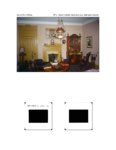
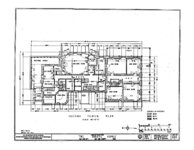
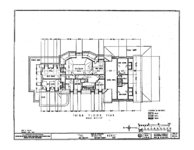
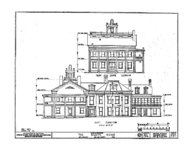
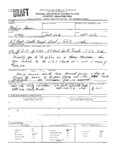
Show United States Department of the Interior National Park Service National Register of Historic Places Continuation Sheet Section number ~7_ _ Page~9 __ roughly where Brigham Young originally had placed toilets at the north end. An addi .:ional stairway was added to the main floor bedroom in order to fae ';.li ta te public use and as a safety measure; also, air-conditioning was added, along with steel beam reinforcements. Furnishings, woodwork, and floorcoverings were installed in the front parlor and central hallway which were thought to be either those originally in the house or authentic antiques of the same style and period. Several pieces of furniture have been identified as originals in the Young home; others are late 19th century Utah pioneer antiques. The second story has been the most radically altered. The 20 second-story bedrooms were described as approximately 12 by 15 feet in dimension, "Similarly furnished," with one door and one Gothic-style window each. In the turn-ofthe-century conversion, the partitions dividing £hese rooms were removed to create several large rooms for classroom space. l Therefore, the interior of the Lion House, with the exception of the main story parlor, does not contribute to the historic character of the landmark. Eagle Gate (Non-Contributing) In 1963 an enlarged replica of the Eagle Gate was constructed at its historic location at the main entrance to the Young complex and to Canyon Creek, where Young was overseer of the city water and wood supply. The new gate represents recognition by the LDS Church and Salt Lake City of the symbolic nature of the property in commemorating an important phase in American history and settlement of the American West, but because of the late date of construction and the vast alteration in scale and materials, the gate is co£~idered non-contributing to the landmark and is located outside the boundary. Endnotes 1 C.V. Waite, The Mormon Prophet and His Harem (Cambridge, Massachusetts: Riverside Press, for sale by Hurd and Houghton, New York, 1867), 195-198. 2William H. Pierson, Jr., American Buildings and Their Architects: The Colonial and Nee-Classical Styles (Garden City, New York: Doubleday, 1976), 66-68; and Thomas Carter, "Folk Design in Early Utah Architecture," in Hal Cannon, ed., Utah Folk Art: ~ Catalog of Material Culture (Provo, Utah: Brigham Young University Press, 1980), 36-59. 3For a general review of the movement of picturesque ideas in American building, see Dell Upton, "Pattern Books and Professionalism," Winterthur Por4folio ~ (Summer/Autumn, 1984), 107-150. Paul L. Anderson, "Truman O. Angell: Architect and Saint," in Donald Q. Cannon and David J. Whittaker, eds., Supporting Saints: Life Stories of Nineteenth Century Mormons (Provo, Utah: Religious Studies Center, 1985), 147. |