| OCR Text |
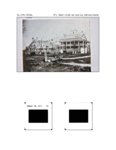
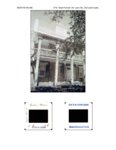
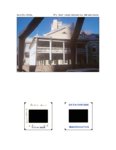
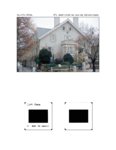
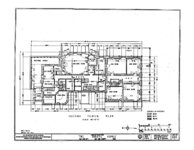
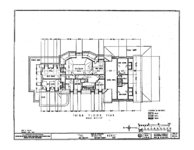
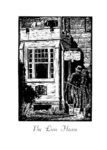
Show ,,,,""~ ~. , United States Department of the Interior National Park Service National Register of Historic Places Continuation Sheet Section number _7,--_ Page _ .....4_ _ Typical of public buildings in the classical style, the main entrance is located at the south elevation gable end. Two double-hung, 12-over-12 light windows with label moldings flank the paneled pine door. The door is detailed with a label molding and a 4-light transom. The front windows and labels perhaps were added in 1854 when the adjacent President's Office was built. Like all the buildings in the house and office complex, the walls are constructed of stuccoed adobe, and the roof is covered with wood shingles. All of the buildings except Lion House have low sandstone foundations; the foundation of Lion House is also sandstone, but reaches a height of over 10 feet on the west elevation. The adobe on all of the buildings is painted light yellow or "creamy," and the trim is white. These are the historic colors. The attached 2-story President's Office, which also housed the Tithing Office, was built to the west of the Governor's Office in 1854. It also is a rectangular, gable-roofed structure with a simple boxed cornice. The facade is symmetrical with two double-hung, i5-over-15 light windows with label moldings that flank the paneled pine door. Like the Governor's Office door, the main door to the President's Office has a label molding and 4-light transom; two double-hung, 6-over-6 light windows with label molding are on the second-story facade. An 1862 photograph shows that a portico with square wooden columns and pilasters, not present in an 1855 photograph, was built across the front of the two office buildings. A connecting passage between the two offices with a large pine French door with sidelights, transom, and label molding was added, probably by 1862, to give the two buildings their present appearance of one continuous structure. The buildings are entered by the central passage door which leads into a long hall with the larger office and gallery on the west and smaller offices on the east. At the rear, the passageway that Young constructed, called the "crooked hall" by his children, has been enlarged. Another passage, now removed, once connected the offices to Young's private rooms on the first story of Beehive House. In the 1860s a gallery was constructed around the second story of the President's Office as a library and storage for the Church and tithing records. An ornately carved oak door at the northwest corner of the galleried office conceals a narrow stairway to a second story room where prayer and private meetings were held. These features are preserved intact. The Brigham Young "Office Notes" indicate continual repatrs and improvements of the offices that have changed other features over time. Specifically, the LDS Church Journal History on October 19, 1881, records that partitions were changed to enlarge the office of the Deseret Telegraph Company, then housed in the building to accommodate increasing communication needs. The north, or courtyard, end of the structure has been altered for easier access to the courtyard and between the buildings, and a half story was added to create a rooftop terrace also with access from the courtyard. These changes |