| OCR Text |
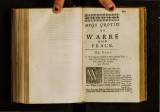
Show of WAr 4nd Pe4ce Barharians enemies to· themfelves, as it: were naturally, by reafon of tht-n diverficy of man,;er$ , and haply becaufe_ they fee;m d in[eriour in ·wit. Yet , ·for fo!pe gci.e~ous hns, and. iuch as oppugn nature and human iociety, we derry not but do- _. . . minion may be taken away. Moreover , a. unro/.1.1"· . Liberty • * ,, whet he r of fim g 1e penro ns , or t Vide Conctl. of Commonwealths , as if it did natural• ~'aroletanum~ ly and always ae:ree•to all, cannot yield a p""ttppa rex · fJ • • • apudJofcphum right to wart· Fnr, when hberty 1s fa1d in oradone aCf to aoree by nature ·tQ a man or people , ju~'zos,.<fUi ex' that0 is. to be underfiood of the.right of Pra·l poflt'ebrcor rtae -N a~ure prece d'1 ~ a ll hu man f:a ~.a~., m· t h'IS petHZ 1 • • LJ • tis fiudio ze- ien(e *· , that one 1s n.ot a fervant by na-lorz ditti ture; not that he hath a right never to befunt , fie _:~it : come a fervant ; for in this fenfe no man is ~~tempcfll~bvum free. Here is pertinent that of Albutius: tJ~ nunc t erta- . tem concupi[ce'- No man is born free, no man u born a .fer-re. Olim nc ea vant : thefe names were impos'd afier.• mitteretu~ c.er- ward upon every one by .forwne. And that latum opo;~uJt._ of* ./Jriftotle:lt u the ejfetf: of Law, that 1(amfervltt4tU . ~ h pericllllim [acere one zs .free ,anot~er ferve s. Whe:rer.ore t ey drJrum eft;&ne that upon lawtul caufe are come mto fe ridfubwur? o- vitude, whether perf'onal or civil, ought nefla c~rtatzo. to be content with their conditionf as ::tl- ;:b~~je;';;fcu, fo Pa11l the Apofile teacheth, A.rt thou non libertatu a- ' . Vta1l! dicendtU i{l,fed ftr'U/14 cimtiimax. Atqj. i pf'e; Jofcphus ad eofdcm: H~neflu"! q~id_em,e(l prtgn~tre pro ~ibertate ~fed id o~itp f~Ct~~~ opoiwit. At q!J' viflz (emel (H11t, , & long~ temrore parut~Jnt,ft fugll~ excuti.ant,[actwnt quod defperatoru'llJ bomm~m e~, non. q~od. iebe~t~ tem ama·ntium. Eadem fermc verba repenes m orauone Corl1Jt•$ Bbnliledrehfili ad Mediobnenfcs apud Radevic,um r. c;~p. 40· "'lntellir,endum de ti,bert111.te lt9'-rrl r;ep•n•,non deea IJIII' efllt1'~': ;'"'1 1° 111 " 1,111. Seneca, 3 ~ Con'tr. :1.' x'. *·I Pvfit~ · c a!! d 'The fecond 4 I 5 taltd to [ervitude? Let it not vex thee. 1 Cor.7.u; · Farther , it is un juH , to fubdue by arms any , as if they were worthy to ierve , whom Philoiophers fometimes call natu-rally fervants. ·For , fuppofe a thing be profitable for one , it doth not therefore prefently follow, that 'tis lawfull for me"' Jus exercento force it on him. For, they that have d~ "·cnoc-&-)'it~ e ufe of reafon,ought to have a free ele- ~;· .cz d 1 d \.An. ·l On of t h'm gs pro fi ta bl e an d unpro fi - r2 .+sw· . e n • "· table, unlefs another have gotten iome Ayala de ju. right over them. The cafe of Infants is belli. lib. I. quite other-wif~,whofe government,feeing c,"'ar. t. pte- . h h * d h . "trem p.1..[tfl.o t ey ave not power to mo erate t eu 9• n. ~.&c. Ad own acHons, nature comm_itteth to the leg. aojltJ D. de occupant, or fome fit perfon. capt.t.~hUJt. · 11.dl. Rbod. ex. Of the Titk ofuniver- t Ut in cone. J r chalcedon. ACI. Jal Emptrour. 1 I. & 1%..- * llt & Ath:r- 1 Would fcarce adde, that it is an unwife ~us ad S?liu~ title which fomeattribute co the Roman °05 • ld vtx; :E mpe.rou, r , as 1'f h~ ha d a n.g h't of com- eferxatta m puanrdsi ~ndmg over nauons moH remote and tunc crgnid. hitherto unknown ; unlefs Bartolus, long t Philo deleaccounted the Prince of Lawyers , had gati?ne :, ~~ ventured to pronounce him an here rick pt~:zbusbz~ttlJ/]i. th d · f, r h b mz1qj m u par. at enyes lt ;. ono~t , . ec3-ufe t~e tibu6 Loquor, ~ Emperour fometune fldes htmielf lord qutU & tmjof the world t; and becaufe, in Scripture, immr aliq11il _ that Empir~,which lau:r Writers call Ro- orb~"! appellet., m_, ~m·a *. ' ·IS ca.l l"d by name of the word, t bdue-fsi mdutunbmtU a mEnuz-· .,~ .•~••t41!•c. So 1s that of the Poet, The Ro-phr•&e & !<beman (onquerD_Hr held all tht world, and no, - many |