| OCR Text |
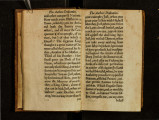
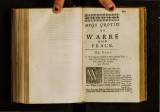
Show colltruy, Paul taith , the High-Priea was let to gJVe judgement 11c~o~dmg to the Law of Mo(es. ChriH him!elf in the preface to h1s precepts iaith, He came notto dtjfulve t~e Law, but to .fulfiLL it; the fenfe of -whtch -words, as to Rituals is not obicure : for the lineaments and fuadowings are filled up and cot~plea· ted, when the perfeCt fpecies of a thina .l S prei.e nte d to our view; as to the 1udib· cial Laws, how can i\! be true, if ChriH asfome do think, hath by his cotiuniif; taken them a way ? But if the obliaatio~ of the Law remained, as long ~s the Common-wealth of the .Hebrews flood, it foHows, .that even the Jews converted \mto ChriH, if they were called unto MagHhacy, could not iliun it, and that they ought to judge no otherwile than UUo[es had prefcribed. Methinks, when I weigh all thinEs, there is not the leaU motive for any pious man, tha~ heard Chrill at that time fpeaking, to undet· Hand his words rn any other fenfe; .Thil ~acknowledge, before the time ofChri~ ~orne things were permitted, (wheth~r 10. ref peel: of outward impunity) or allo of mward purity, I need not determine:) which ChrHt bath forbidden the Dilci· ples of his inflitution, as, to put awar ones wife for every caufe, to feek reven! from the judg upon the injurious perfon: -yet, between the precepts of Chrifi a~ thofe permiffions, there is a certa'1n di· vcr6tf, The flrft • verlity ,no repuonance F his ~.ifc, anl'remits. th~l' f~ ~hat keep' nothmg againll the L JUry, doth that which the Law ~lwl ' yea he doth h , r • WI , s mo!l 'T· t erwhe with the J d • 1s onot perinits but u ge, whom the Law M d , ' commands to h ur erer to death h' 1( If b put t e guilty of blood b;~ ,tm e ccomming this cafe he lhed it. 0 {[ c~o.d, unJ~fs ~ .t hus1 t.o p,u niffi the h. d :.~ nfi: forbtd him JuUr e~r h. s IS p amly contrary t:> th I , hl P.rccept eth the law. e aw, e dtffolv· XIX-•. !he Stxt, Seventh, and \ Etghth Arguments. THe lixth is from th r . ' nelim the Cent ~ e:&le of Cor::. from Chrifi the Hoi , u;~~~? . who received fign of his ;'ua·f·i "' Y. pmt, an undoubted t1· zed in the nht :" 'atton ' a nd was Bap- ~oH. le ame of Ch •fl. b Peter: but th h , nn y the A-of \Var, or wa~ a~t. e teft his Office leave it we don vdtfed by Peter to h ' ot rea s . w ere as he had · a r{. orne ani wcr . lflHl'U\;{10fl fj ' concernmo Ch ·a· R. . rom Peter b o rtntan ]' · · e fuppofed that he e tgwn, it is· to ~0 d.efert his place Th~s alJo inflru&ed ~ it were certain" and ''~~dre fomething, hntt a.mono th ~ . oubred that had forbidde~ Waer r~ of his precepts no where elfe exprcffi d u~, when that is a fit p~ace to fay ~ e ' ere at.Ieafi wa; the age to come miD~~e what of i~, that t not be ignorant of 33 r; .. |