| OCR Text |
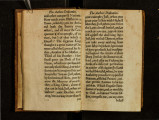
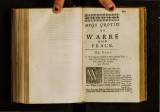
Show I 50 Of' War ,AtJd Peace fome L:1ws of God , although generally exprcft , have a to.cit excep tion of extreme necdlities : which in the time of the H11.[moneans ~as defined by wife , men concerning the Law of the Sabbatll. Whence it is a common faying, Peril of life drives away the SPI.bb~tth: and a Jew . . . iJl S·y;tcjit1s gives this reafon of neglecting ~b zdJt ewzmb 'lltY- the Law of the Sabbath,We 'l-rere brought a onat an. . .n. . d f f 1 Ma"· '· 9 • mto moJ• certam anger o fJUr /~ e.Whi\h 44· · · exception i, approv'd by Chriil hirnfclf: · as alto in another Law of not eating the fl1eY.I-b1·ead. And the Hebrew matters, out: of the old tradition, adde the fame exception to the Jaws of forbidden meat1, a od to feme other : And rightly; Net that God mty not bind us over to tain death , if he plcaie ; but , be certain laws are oHuch an argt:men it is not credible they w~re given out rigid a wi\1. Which hold~ more in humane 1aws. I deny not , but a humane law may command feme of venue under certain peril of death. ~V~dt Jo{t- the law of nor defertin" ones .. Station · phum ~liz de cu• 0 ~odibt.~s Sauli4 but we ~~It not rafhly conclu de , that agit. P oly b. was the ¥Jtll of the Law. maker; nor~o fffl~ P01~;.,, men feem to have taken io much righto. a.r~ · or0' lA! ver themfelves ami others, but fo. faot ~~::1:~ ::;nn extreme ncceffity rc')uires it. For Ia~' r;LW ,.a:~"· are wont ( and fo they ,ought) to.~ ., made by men with fenfe of humane till' bcci\lity .Now the law of which wefpe31, fccmes to depend upon their will, ~~l ·· 1lll The Firfl Part. ~rfl: confociate themlelves into civill foctety , from wh~m thenceforth a rjght flowes ~nd comes unto the Rulers. And th~fe ' lf th7y were asked, whether their Wlll was to 1mpofe upon all thi! burden to dy rather than in any cafe to repeli , by force the force of the1r fuperiours I ~now not whether they would anfw~r .1t :"'as t~eir will~ unlc:fs perhaps wid~ ,th1s addJtament; 1f rcliflance cannot be made without very great perturbation of the Commonwealth, or the defiruetion of v_cry many innocent perfons. For, wha; m fuch a circumilance charity would commend ' may be ~lfo I doubt not , deduced into a humlne Law. One may fay , that rigid obligation, to dy rathe: than ever to repell any injury offu-e: nours ' proccedeth not from humane aw, but from divine. But we mufl: note Men at firfl: , not by divine precept bu~ ~rawn of th~ir ow.n accord upon ;xpe~ nence of the mfinmty of divided families to defend themfelves aoainH: violence '~ofed together in the bond of civill fo: cte~y : wh~nce civill po'fer hath 'its fprmg, wh1ch therefore Peter, calls a hH- ~~ne orainan~e~ *though elfewhere too, it I Ptt, s. 13. 1s ca.lled 1t D~vtnt ordin~tnct,becaufe God ltoTif. 1S• app10ved thts wholfome inltitution of . ~n. But God, approving humanelaw ~s fuppofed to appro;vc: it as humane and ~n a humane man~er.J BArcl~ty, the'moH J.uctaitu lth-J. nou~ ~efender of Rcooa ll Pow er , d e fcc cn- d•dmtJn. .M ,.•pn.• ;·s-. · dcth |