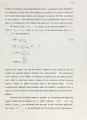
| OCR Text |
Show 61 technique seems to be at least O(m3) )." Overall, the combined method seems to be reasonably effective in reducing the error when optimization is desired. 3.6 Optimized Adaptive Knots and Reparametrization It is important to establish how useful a combination of all of these methods can be. The purpose is twofold: if they can be combined in such a way that the improvement in the approximation justifies the time it takes, then the application is obvious; if not, it will still provide a standard against which we can compare simpler methods, and may be used when interactive speed is not essential. In section 3.5, the increased effectiveness of combined reparametrization and knot optimization on an approximation with a fixed number of knots was discussed. The motivation for performing this optimization earlier, while the knots are being selected, is that it may be possible to reduce the number of knots required to fit the data within a specified tolerance. The number of knots required affects more than just the compactness of the result. Optimization of parameters and knots reduces the error of the ap-proximation, without adding more degrees of freedom. If knots are added to reduce the error, the shape of the approximation is more likely to also ap-proximate the noise of the data. In addition, the smoothing properties are reduced, and the approximation may begin to make wild excursions between data points. The interaction of adaptive knots, reparametrization, and variable knot techniques is very complex, so a combined method must be carefully designed to tap the full power of the optimizations. The reparametrization process is very sensitive to the initial approximation that it is given. If that approximation * See examples in section 3.6 for timings of each phase. It is important to note that the variable knot package and most of the math library is the author's own implementation, and time constraints required a higher priority be placed on verifiability than optimization. Jupp (14) shows very different timings, which are not explained by the marginally lower complexity of minimizing the error of an explicit approximation rather than a parametric one. |