| OCR Text |
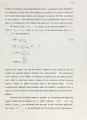
Show 51 subject to the constraint n I ( w i II f{t) - ci 112 ) ~ S, j:a 1 for data points ci with parameters ti, and knots ).f S is the user specified "smoothing factor," and can also be thought of as the expected error of the ap-proximation. The algorithm begins with a least squares 8-spline approximation with no internal knots, then iteratively adds knots and computes a new least-squares approximation until the error of that approximation falls below the desired error S. The number of knots added each iteration is determined from the number of knots added the previous iteration, the error reduction as a result of adding those knots, the error of the approximation, and the desired error S. Each knot is placed in a region of the curve where the L2 error between two consecutive knots is large, and two or more data points have parametric values between those knots. The parametric value of the central point associated with that region is used as the new knot value. Once enough knots have been added so that the error of the approxima-tion is less than S, a smoothing spline with the same knots that minimizes the jump criterion (2.4) is found with error approximately equal to S. To do this, a value of p, which controls the tradeoff between smoothness and closeness of fit, must be found that produces an approximation with that error. This value is computed using iterative rational interpolation. Diercl<x knows that such a value exists, since the error based on the pseudo-distance, which is what he uses, is monotonically decreasing with respect to p, and S is less than the error of the smoothing approximation for p = 0 and greater than that for p = oo. 3.3.3 Author's Implementation The author uses a similar method for producing a smoothing approximation, with some major differences. Knots are only added one at a time, to ensure that unnecessary knots are not added. An estimate of the true distance, |