| OCR Text |
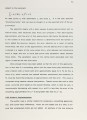
Show 2 1.2 Statement of Problem It is often necessary to produce a smooth curve or surface from a set of data points or points digitized from a rough sketch of a curve, such that the result captures the general shape of the data, without also picking up the noise. Explicit approximation is used in some applications, yet curves used in design may not be explicit functions in any coordinate system, so a more general representation is required. A parametric representation provides this freedom , yet also presents the problem of selecting a parametrization for the data points. Approximation is ideal for interpreting a set of data points, when it is important to capture the general shape but not the noise. The exact measurements of a real object are seldom available. Data taken from engineering drawings may suffer from errors in digitization, slight errors in the drawings, or the limited precision of the tablet. Economizing on space by storing large sets of data with low precision induces a quantization error in the data. Approximation has the power to capture the general shape of such data, without the wiggles, severe overshoots, or loops that interpolation produces. Approximation by explicit functions, e.g., y = f{x), comprises the bulk of approximation theory. Such a representation is appropriate if the data being approximated can be thought of as sample values of a scalar-valued function. Unfortunately, many interesting object boundaries cannot be expressed as explicit functions [9]. Parametric functions f{t) = [x(t), y{t), z{t)] are capable of representing a much larger class of curves, including explicit functions. Furthermore, parametric approximation is independent of the choice of coordinate axes, unlike explicit approximation. Parametric approximation is a more difficult problem, however, since it requires that a value of the parameter t be associated with each data point, and the •closeness" and shape of the resulting approximation is strongly influenced by the parameter values used. Since the computation of values of a polynomial is relatively inexpensive compared to that of exponential and transcendental functions, approximation by polynomials, piecewise polynomials in particular, is important in numerical and |