| OCR Text |
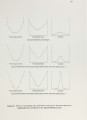
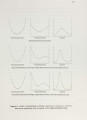
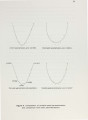
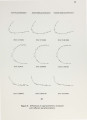
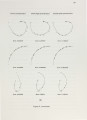
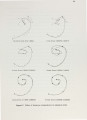
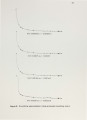
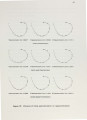
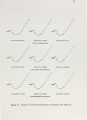
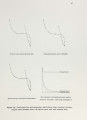
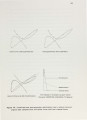
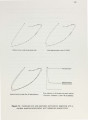
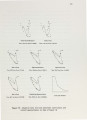
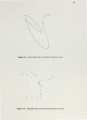
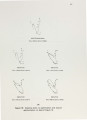
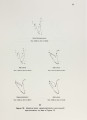
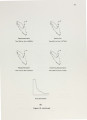
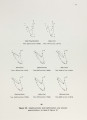
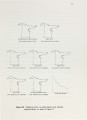
Show 46 3.1 Effects of Initial Parametrization on Reparametrization The examples of section 2.2 show the error reduction possible when using reparametrization in 8-spline approximations. Since the results of reparametrization depend on the initial parametrization, these effects should be explored in more detail. If a better initial parametrization is used, reparametrization is more likely to lead to an approximation with the globally minimum error. In addition, a few cycles of reparametrization can be expected to result in an approximation with a smaller error if a minimum is nearby. The results of several cycles of reparametrization are shown in Figure 10, beginning with uniform, chord length, and variable speed parametrization, respectively. The initial parametrization is more crucial in some regions of a set of data points than in others, since all errors in the parametrization are not resolved equally well. For instance, on an approximation with the appropriate number of knots, reparametrization tends to be more effective in regions of the curve with many datapoints for each knot. In such a region, the approximation cannot be influenced too greatly by the parameter of any individual data point. This implies that the shape of the curve in such a section will not change greatly, leading to faster error reduction in such regions. In regions with fewer data points, a small change in any one parameter value might drastically change the shape of the approximating curve, so error reduction can take place much more slowly. The implication is that if the initial parametrization is close to optimal in regions where data is sparse, reparametrization will work well. This appears to be one reason for a greater final error when chord length or uniform is used as the initial parametrization. The uniform parametrization works poorly in sparse regions because the interval is large compared to the other intervals. The chord length parametrization does not vary depending on the flatness or curvature of the region, and may either bulge out unnecessarily or be too flat in large intervals. For the reasons discussed, such errors may be reduced only after many iterations, or may cause the parametrization to converge to a min- |