| OCR Text |
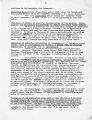
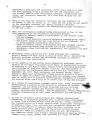
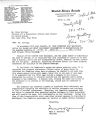
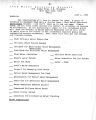
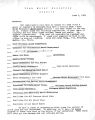
Show HOW DOES THIS REPAYMENT WORK OUT IN PRACTICE? Members of the board of the Central Utah Water Conservacny District are appointed by the Fourth District Court in Provo. Although they are not elected, they levy taxes. Many of the counties In the Water Conservancy District are not in the Fourth District Court jurisdiction. This constitutes taxation without representation. - in order to sell irrigation water to farmers for $5 per acre foot, municipal and industrial users will be charged $125 - $200 for the same quantity. This represents over a $1,000,000 subsidy to each full service farm In the project area. It is an additional charge industry passes on to the consumer. - this is a double subsidy, since your federal taxes support this $1 - $3 billion dollar project to begin with. Utah's Congressman Marriott states that Utah citizens will repay 85% of CUP. However, there are as yet sizable non-reimbursable funds which the nation pays such as Section 208 Mitigation Funds and costs of the salinity program - Salt Lake County taxpayers will pay 60% of the cost of CUP even though they will receive only 20% of CUP water. (Is this a triple subsidy?) - Duchesne County water will be transported to the Bonneville Basin yet the County is contracted to pay $35Q,000 annually for this water they do not receive. In turn they will have to buy CUP water they need.,. When the Bonneville Unit is completed, there will be no way farmers in Hanna and Tabiona areas can get water from a reservoir 40 miles downstream to Irrigate crops in a dry year. Representatives on the Conservancy District are appointed by Judges and then by the State on the basis of county population. Duchesne members are continually outvoted by larger counties when trying to press for equality of taxation and benefits to the county. - The Strawberry Collection System presented to the public as an Irrigation System, has been changed to an M & I System. Farmers have been paying property taxes in anticipation of receiving supplemental water services. Will the change from agricultural to indistrial uses recover what they have been paying? (p ALTERNATIVES We think - efficient and cheaper non-structural water management by the State is a viable alternative and should be a primary objective at this time: to save costs to the taxpayer, to address contemporary federal policy for the nation's waters, and to protect outstanding public resources. Conclusions of Salt Lake County We 208 Water Quality Studies and Utah State University Water Research Laboratory support this belief. Salt Lake County 208 Project has proposed a $40,000,000 (4% of CUP costs) dual water system which would make use of Utah Lake water as irrigation use declines in the area. This would produce, ultimately, 350,000 acre feet of water - adequate for Salt Lake County needs. - Salt Lake County has 40,000 a f of ground water, more if ground water recharge is used - 40,000 a f of stored, unutilized water is in an existing reservoir, Deer Creek - about half its capacity - 35,000 a f of Big and Little Cottonwood Canyon water is still being used for irrigation - 50% of Salt Lake County's municipal water Is used for outside watering. - coordination among 48 Salt Lake County water suppliers is lacking - non-computerized water rights adjudication procedures in Salt Lake County take ten years to complete across the Salt Lake Valley. At a time of rapid conversion from rural to urban water use, the Department is wholly unable to keep up-to-date. Deliberate failure to modernize, obstructs State management. We think - that similar available water resources and opportunites for State management will be found to exist in Mountainlands and the Uintah Basin as viable alternatives to CUP development. think - that the CUP is an at-all-costs water development: at all costs to the environment" to natural primitive recreation uses, to management responsibilities of" State and" Federal wildlife and lanoTmanagement Agencies" - as well as to "all taxpayers-The magnitude of loss, over time, is incalculable. Like a giant octopus, its water-grabbing tentacles will reach into every nook and cranny of free-flowing rivers and wetlands - leaving behind beds of rubble and undetreminabJe disruption of aquatic and terrestrial ecosystems '"" " ^ a |