| OCR Text |
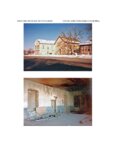
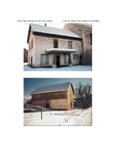
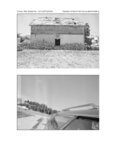
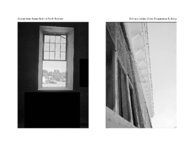
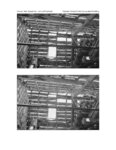
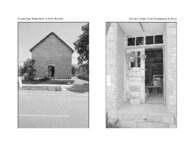
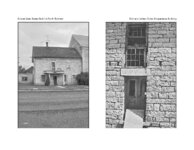
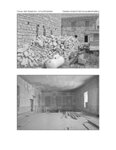
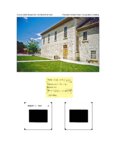
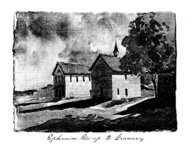
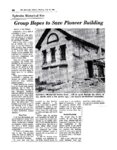
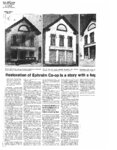
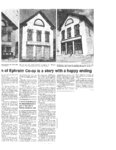
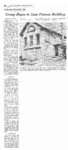
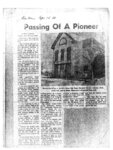
Show contribute to the economic development of the area? It cannot, at least directly. But indirectly, a restored Co-op, anchoring a main street historic district that includes the Relief Society Granary (National Register), the Dorius-Enterprise building (determined eligible for the National Register), the Bishop's Storehouse (National Register), and the Canute Peterson houses (National Register), could form the nucleus of a resurgent Ephraim. Right now it seems to me Ephraim suffers from a kind of identity crisis. True, it is the home of Snow College, but the campus itself is located to the east, off the main street, and out of sight is also often out of mind. I think I speak for more folks than myself when I say that my first impression of a community is often a lasting one, and that this impression is often a factor of an eye-catching feature such as a building, a park, or the like. Manti, Mount Pleasant, and Spring City each have their own distinct pel~sonality, an identity shaped by particular histodcal circumstances ~!td theil~ al~chi tectural l~esoul~ces. Manti is the Temple City, and the temple stands there on the hill to remind all people, residents and vistors alike, of this fact. r10unt Pleasant was the commercial hub of the al~ea dudng the economic boom of the late nineteenth century, and its well-preserved main street commercial district reaffirms this identity. Spring City is the valley's I~es idenhal communi ty --_. the Mormon village, and people are attractE:~d there by the presence of the old chapel and many early historic houses. Ephl~aim is the educational center, the college town, yet there is nothing at pl~esent that bespeaks this fact _.- no recognizable landmark to announce to passersby that Ephraim is the educational and cultural heart of the valley (and therefore a good place to live and work! !). The Noyes Building is one likely candidate for local landmark status, but is problematic for several reasons. First, since it is tucked back in the trees off 100 east, it lacks the arresting visage that is found in a building like old Main at Utah State University. Second, the Noyes Building is a piece of good historic architecture, but it does not have the design impact that one finds in, say. the Park Building at the head of the circle at the University of Utah. The one stnlctul~e [phl~aim do~~. have that satisfies the basic landmark criteria is the Co-op/Sanpete Stake Academy building. It is (or has the potential to become) an architectural gem (with no equilivent in the state), it has a clear connection to Ephraim's early history and its rise to excellence in education; and it occupies a conspicuous place on main street. The danger Ephraim faces at the present is one of cultural anonymity. of becoming "ever'Yl",hel~e 01" anywhel~e Utah. I think of towns like Fairview, Fountain Green, and Moroni as towns that have little personality. When the Moroni tabernacle was destroyed, it was like the town lost its soul, and now stands, nOI1 ..-·descl~ipt, on the I~i.'athel~ bal~l~en nor·thern I~eaches of the valley. Ephraim is lucky to have one truly monumental building left, and also lucky that this building (perhaps even more than the original tabernacle) is so closely linked to the town's distinctive history and development. Without the Co-op/Academy building, Ephraim's main street becomes just like countless others around the state, and in so doing becomes just another little Utah town that failed to make it into the modern world. The rebuilding of the Co-.. ·op/Acadern.v building could set"ve as a ralJ.yin~J point fOI~ the town, and a place to start rebuilding the community's confidence in itself as well. II |