| OCR Text |
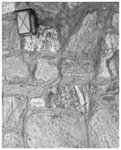
Show CHAPTER 10: U t i l i t i e s ' - - - - - - - - - - - - - - - - - - South Weber got natural gas in the fall of 1938. And like UP&L, there was a contingency: Everyone had to buy a gas range and a water heater. There were two ranges available: Magic Chef and Roper. WATER. The first settlers in South Weber in 185111852 (Byrum and John Bybee) chose the river bottom as the location for their first homes for obvious reasons. Without water there was no way they could survive and they wanted to be very close to the supply. So one could safely say that the first deed of the newly arrived South Weber citizens was to seek out a steady source of water and as with the citizens of every other community the world over, to maintain that stream. Over the years this was one of the primary responsibilities of the local residents. 121 22 February 1876: to illustrate how water shares and similar transaction were made at the time, consider ·the "water share deed" which follows : "DAVIS COUNTY, February 22, 1876. This is to certify that I, William Alford, have sold to William Thornley, my right of water claim which is one-half of the whole of water that flows from what is known as Corbet Canyon situated southeast of my farm. The same water belonging to my farm which is known as Simmons Farm which is on Location 36, township 5, northern range one, west of the Salt Lake Meridian Line. I sell to William Thornley the. said water right for the sum of seventy-five (75 dollars) and have received one red cow for thirty dollars, and one gray 2-year old colt for 35 dollars, and one red calf for 10 dollars, making in all the loan of 75 dollars for which I transfer all right and title of said water claim to William Thornley. Signed: William Alford (his mark), Hiram Alford (his mark). Witness: John Hill Figure 151. TheAvaiJability ojWatuFrom the Weber RivuMade South Weber a Desirable Place to live. By the time Mark Hall arrived in 1852, he stated in his journal, "They all lived in log houses and had already secured water for irrigation purposes by tapping the Weber River." The conduit to which he was referring was the South Weber Ditch which, after the Pioneer Ditch of Uintah, was the oldest ditch on the river. "Also, in 1853, the settlers enlarged the water supply," whatever that implies. It probably means they dug better and larger ditches. .~nTTTT-l Figure 152. Ripping up Trees to be used in Flood Conrrol. OGDEN ARMY ARSENAL. In 1920, the United States Army developed plans to build an arsenal in Sunset, Utah. In the construction of that project the availability of culinary water was a definite concern. After considerable study, the Army purchased tbe WFRPR T-ITSTnRY |