| OCR Text |
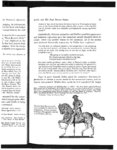
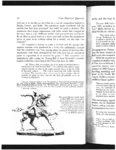
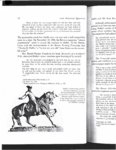
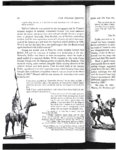
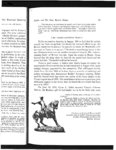
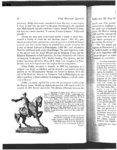
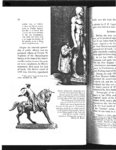
Show 16 Utah Historical Quarterl)· more fitting with l;\'hich to honor the prophet and the people than a portrait statue in bronze of Joseph Smith.~· Whether Dallin received an answer from President Taylor to his proposal is not known. Coincidentally, however, Mormon businessman Hiram B. Clawson and his son William R. Clawson, an art student at the Academy of Design in New York, called on Dallin at his studio in October. Impressed with DaHin's competence, the elder Clawson encouraged Cyrus to come to Salt Lake City and promised to use his influence in securing commissions for the young sculptor. 2 5 At the same time additional good news came from Boston's Museum of Fine Arts where Dallin had entered his Revere model in an exhibit of contemporary American art. An art critic compared his statue to Thomas Ball's equestrian of Revere which was also in the exhibit: No feature of the current exhibition ... is in its way stronger than the statuary. Most visitors will perhaps look first at Ball's bronze figure of Paul Revere on horseback, "The Mercury of the Revolution," but doubtless not a few will confess that it does not fill their ideal. Both horse and man are well modelled, and both are intended to express the utmost speed of motion; but somehow they don't express it. At least the horse does not. ... If Ball himself were to view this lack in his work, and compare it with the spirited action of Dallin's plaster cast of Paul Revere . . . he would confess that the neophyte got ahead of the veteran in one respect at least. In the young sculptor'S work there is a perfect whirlwind of speed in both man and horse, while this force of expression does not detract from the reality of either. It is certainly a remarkable piece of work for so young a man, one of those things that make one fear it may be too good, as promising more than performance can redeem in the future.26 The wavering Revere committee should have been moved to more positive action by this glowing evaluation, but the critic's closing statement was the key to the committee members' indecision. They, likewise, had doubts that one so young was qualified to carry out such an important commission as the Revere statue. ~7 Dallin now experienced all of the faults of the open competitions-the jealousies, lack of funds, and indecisions of legislators-that more experienced sculptors avoided. Months passed without any action by the Revere committee. Finding little work in Boston, Dallin's thoughts again turned to the West. On January 13, 1884, he wrote a second letter to President John Taylor: .. Dallin to Taylor, September 11, 1883, Archives Division, Historical Department, Church of Jesus Christ of Latter-day Saints, Salt Lake City. os Dallin Biographical Manuscript, p. 9. .. "Art Notes," Boston Evening Transcript, October 31, 1883. In Philpott, "Dallin Has Waited 50 Years." and His Paul R The Committee of the present; so I cannot te In the mean time, I h: going to try what I cal in the line of sculpture should be most pleased ' Having received th competition, and to Utah in Fe! be able to make st }rOInmem: men. The Bo in Salt Lake Cit ~';.?;"~, !iUU'I~""~ of his native Te: Cyrus was, . Hiram B. Cla\\'sor .0rnrlOn leaders, but the THE TH1 In mid-June Cyrus to negotiate with in his model. On he to Boston whe ....nJuu~ and began a ne model was studied alterations 1 that DaHin compl 11, 1884. In the day! merits of the mode: of Dallin's meetm .. Dallin to Taylor, JanuaI; .. Dallin Biographical Ma February 4, 1884. Dallin However, he did make a Joseph F. Smith, the to Linden W. Millgate ' 4, 1974, in Salt Lake cit "A Laurel Wreath for Salt Lake Herald, Nc |