| OCR Text |
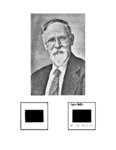
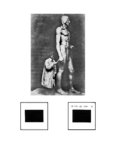
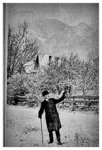
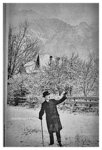
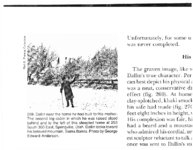
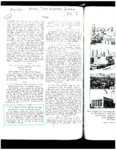
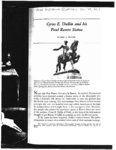
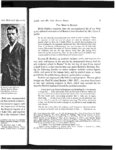
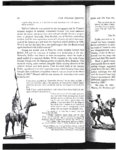
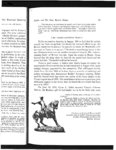
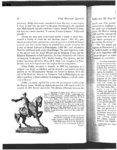
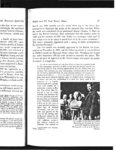
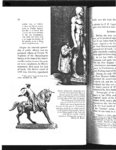
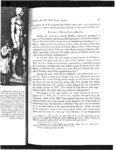
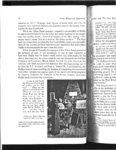
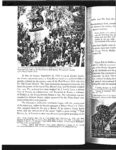
Show ltah Historical Quarterly Dallin and His Paul Revere Statue 9 THE MOVE TO BOSTON Birdie Dallin's transition from the uncomplicated life of the West to the cultured environment of Boston is best described by Mrs. Cyrus E. DaHin: So the boy from the mountains went east, ready to meet adventure. There he expected to find the land of culture of which he dreamed, where people talked as they did in books. When he arrived, the awakening was heart-rending for the homesick, mother-sick boy. The following days were those of loneliness, disillusionment, and even hunger, for he had little money. He entered the studio of Truman Bartlett, who was noted for his art criticisms, but not for any creative work, that gift having been bestowed on his talented son, Paul. At the studio much of Dallin's time was occupied in chores by which he earned his instruction. s his head at age eighteen, , left for Boston. Photo'f the Robbins Library, ., loaned by Lawrence . Both men recommended ack East to study sculpture. :l no means to support such the importance of having the financial support of a t Lake City, and together llin to the sculpture school ng Dallin's clay busts he predicted Dallin's persistent attempts to make prediction. :day Advertiser, June 7, 1931. : William Howe Downes, "Cyrus rohnson, A Brief History of Spring- Truman H. Bartlett, an academic sculptor, critic, and teacher who was fairly well known in the area for his monumental statues, had the only sculpture school in Boston.s In his first day of class Cyrus started a small head of a tiger that he later cast under Bartlett's direction. During the following months the novice sculptor modeled various figures, reliefs, and parts of the human body; and he studied many art books provided by the public library, Bartlett, and his fellow students. Bartlett was impressed with DaHin's rapid progress. His own gifted teenage son, Paul Wayland Bartlett (1865-1925), was away from home at this time studying sculpture in Paris, which may account for the empathy Bartlett expressed toward the youthful westerner: ... I have had in my School of Sculpture and Modelling for a few months a young lad ... from Springville, Utah, by the name of Edwin Dallin, his board is paid by his family and some few friends who are interested in him. He has made such encouraging progress that I wish you to know about him.... As his father is not a man of means, it is not probable that he can afford to pay his son's expenses very long. The tuition of the lad is free, and all that he needs is enough to pay his board and furnish him with clothes. The lad has a fine talent for sculpture, and if properly educated wiII be an honor to himself and to those interested in him .... Natures so eviville, Utah (Springville, 1900), pp. 24, 113; M. Stannard May, "The Work of Cyrus E. Dallin, New England MQ.gazine 48 (1912); Edward W. Tullidge, "The Young Sculptor of Utah," Tullidge's Quarterly Magazine 3 (1884); Alice L. Reynolds, "Interview with Mrs. Thomas Dallin, Mother of the Sculptor," Relief Society Magazine 9 (1922); Alice Merrill Horne, "Cyrus Edwin Dallin," Young Woman's Journal 21 (1910); "Cyrus E. Dallin Scrapbook ," Hafen-Dallin Club, Springville Museum of Art, Springville, Utah; and [William Howe Downes ?], Dallin Biographical Manuscript, holograph, Dallin Collection. s V. C. Dallin, "The 'Great Spirit' and Cyrus E. Dallin," p. 11. 'Wayne Craven, Sculpture in America (New York: Thomas Y. Crowell Co., 1968), pp. 428-29, contains information on Bartlett and his son. |