| OCR Text |
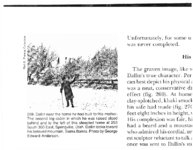
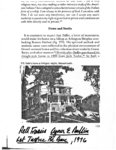
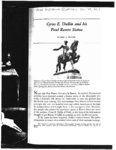
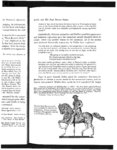
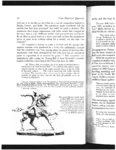
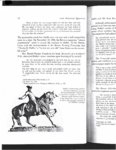
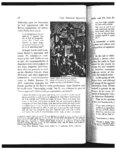
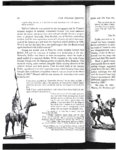
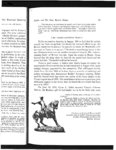
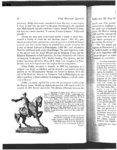
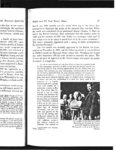
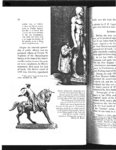
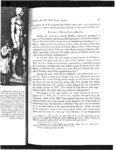
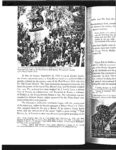
Show 12 Utah Historical Quarterl)' entries were to be unsigned to ensure impartial judging. As inducement, three hundred dollars would be awarded to each of the three best designs submitted. Dallin was probably attracted to the competition by the cash prizes offered. 13 The artists were asked to incorporate in their models ideas expressed in a certain verse of Longfellow's famous poem, "Paul Revere's Ride." Dallin's entry, titled "Waiting for the Lights," was displayed at the Boston Art Club together with the other models that had arrived from such cities as Saint Louis, New York, and Philadelphia. With the exception of a standing figure of Paul Revere, all of the models were equestrian groups.H To his surprise young Cyrus learned that his entry was chosen as one of the three prize winners. For this statue of Paul Revere, which it is proposed to set up in the city, eight models were sent in, and the committee which was to select from these the three best designs has completed its labors. These three models have been placed on exhibition in the gallery of the Art Club. For each a prize of $300 is to be paid, although this does not pledge acceptance of any one of the designs. The entries for the prizes have been closed, but it is expected that other designs will be sent in including one from Mr. [Thomas] Ball. The successful competitors have been Mr. James E. Kelly of New York, Mr. Daniel C. French of Concord, and Mr. C.E. Dallin of this city. The first shows Paul Revere on the Charlestown side of the river, just in the act of springing upon his horse, and casting a quick glance over his shoulder for the lights of the Old North Church. The model which received the second choice, that of Mr. French, shows the rider seated upon his horse, looking over his shoulder in impatient waiting for the signal. The other design also shows Revere seated upon his horse, but is less animated in pose and expression than Mr. French's modeps Unfortunately, none of the three models was accepted for the statue. One sarcastic critic, unhappy with the competition's meager prize offerings and the quality of the entries, accused French and Dallin of being unoriginal. After denouncing French's model, he continued: The second "premiated" model, by Mr. Dallin, although much smaller, is of the same family as Mr. French's, the horse being apparently a near "Dallin Biographical Manuscript, p. 7; "The Statue of Paul Revere," Boston Eveni1lg Transcript, April 25, 1883. "' Downes, "Cyrus E. Dallin," p. 6 (Downes's dates are incorrect); "Rare Stroke of Chance Saves Dallin Statue," Deseret News, July 31, 1937; "The Statue of Paul Revere"; "Revere's Statue," Salt Lake Herald, November 30,1884. ,. "Art and Artists," Boston Daily Globe, April 29, 1883. Daniel Chester French, who became famous as the sculptor of the Lincoln Memorial in Washington, D.C., and of other great works, was thirty-three at the time of the Revere competition. Dallin was twenty-one. The two artists became close friends. relative of that which years on the Boston Pl ease of attitude whicl statues. 18 Undoubtedly, this 1 unknown reputatio . There was anOl declared historica The first time we sub to see that each entra seated on the horse a Longfellow put it: "He spi But ling Aseconl But some erudite gen declaring that not on! that the immortal LOJ off on the wrong met not wait to see the "la: knew the British were Eager to prove hi] =! .ULl:~!U'U to submit a was granted. VI _ ,. American Architect an, Ball's equestrian of Washington live horses were still seen on J would have remembered horse: Dallin: Let Justice Be Done," B 31 Rabbette, "Ashes of a F Paul Revere model Dallin in 1883 for t, ""J~e'l~n'o n Present locatio "'''''TL(]WI'I.. Photograph court Robbins Library. |