| OCR Text |
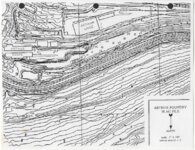
Show on aerial precipitation maps compiled by Hely et al. ( 1971 ), the average annual precipitation at Kessler Peak, southeast of the Smelter and 4500 feet higher, is about 20 inches per year. Ambient temperature in the North Facilities region is largely influenced by altitude and land features. During the summer months average temperatures near the Great Salt Lake are considerably higher than in the Oquirrh Mountains. The recorded temperatures at Salt Lake City International Airport range from average highs greater than 90 degrees Fahrenheit (F) in July and August to average lows near 40 degrees Fin December and February (Hely, et al., 1971). Evaporation rates have been recorded at Saltair using a Class A pan. For the period 1956 to 1986, the average annual pan evaporation rate was 74.6 inches (ETA, 1992). Monthly evaporation rates range from an average high of 14.4 inches in July to near zero for the months of December through February. Wind direction in the North Facilities region is predominantly out of two directions; east-southeast and west-southwest with an average wind speed of six miles per hour. C.2.3 Geology and Soils The Kennecott North Facilities are situated on sediments eroded from the northern end of the Oquirrh Mountains. The Northern Oquirrh Mountains are composed of thick sequences of folded and faulted Pennsylvanian and Permian sedimentary rocks of the Erda and Kessler Canyon Formations, respectively (Tooker and Roberts, 1971 ). The bedrock is composed of alternating sequences of limestone, dolomite, sandstone, quartzite, and shale. The Erda Formation outcrops in several areas south of the Facilities. Overlying the bedrock are Quaternary alluvial and colluvial deposits derived from the local bedrock and consist of clayey to sandy gravels. These deposits merge and interfinger with the Quaternary lacustrine and deltaic valley-fill sediments along the base of the Oquirrh Mountains. Heterogeneous mudflow sequences influenced by historic torrential rains occur throughout the area. The mudflow units and interlayered gravelly sequences are interpreted to dip to the north based on lithologic correlation. The surface of the Quat_ernary alluvium has been shaped by inundations of historic Lake Bonneville, which created wavecut benches and shoreline erosion features. C.2.4 Surface Water There is no perennial surface water in the North Facilities area, but seasonal and storm water runoff does occur in the watershed. Due to lack of vegetation throughout the watershed, peak flow during runoff events can be high and erosional features are present. Surface runoff in most locations is diverted into a network of ditches and collection ponds, and some is directed to the water recycle system. Several water bodies are located north of the Facilities including the Great Salt Lake, several springs, and wetland areas. Appendix C* 3 July 18, 1996 Rev. C |