| OCR Text |
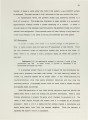
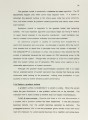
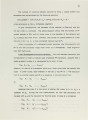
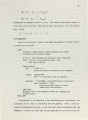
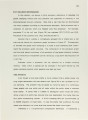
Show PP(i) = min { 0, some positive number } = 0 w(i) = min { d .. because g(i) = 0 1,1 = 0 PP(i) = w(i) case ii: k <> i g(i) = wmax PP(i) =min {wmax, 1+ min{ w(j) over j, d .. :1}} I,J Since w(j) < wmax, hence, 1 + w(j) <= wmax. PP ( i) = 1 + min { w( j), over j where d .. : 1 } - Substituting w(j) with the definition 2-ij, w(i) = 1 +min { d. k, over k where g(k):O, J, and over j where d .. = 1 I,J = min 1+di.k' over k where g(k):O, and over j where d .. : 1 I,J = min { di,k' over k where g(k)=O } = PP(i) 2.4.2 Load mig_ration 32 A new task may be generated after a gradient distribution has been es-tablished. On the other hand, excessive load may exist while a new distribution is being developed. In either case, the gradient model commands the extra task packets to start moving toward the closest idle node. The closest idle proces-sor resides in the direction of the neighbor with minimum proximity, because the smaller proximity means that the processor is closer to an idle node. As discussed earlier, the gradient model use prop~gated pressure to approximate the proximity function. Therefore, routing of excessive apply tasks from abundant nodes is directed to the neighbor of the least propagated pres-sure. . There is no ultimate destination assigned to an apply task when it is moving in the system. The proximate destination of an apply packet is designed such that a localized balancing is easily ac.hieved. Ultimate balancing of the system is accomplished through multiple overlapped local balancing. Such a load migration procedure continues until one of the following con-ditions is satisfied: ( 1) The apply packet arrives at the idle node, or (2) Some other apply packets arrive at the idle node and convert the idle node into |