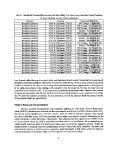
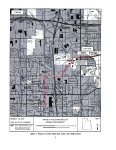
| OCR Text |
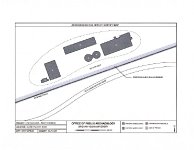
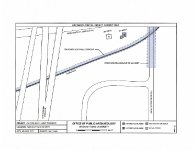
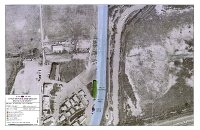
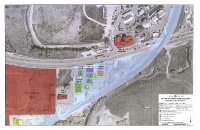
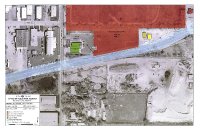
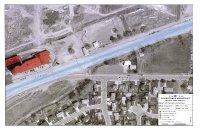
Show (80 feet) south of 7800 S. A railroad-tie retaining wall, also on the east wall of the canal, was located a further 18 meters (60 feet) south of the diversion box. A small, one-room shed, located 23 meters (75 feet) west of the canal, sits approximately straight across from the diversion box. Site mstory: The North Jordan Canal originated as the Gardner Mill Race, constructed in 1850 along the west side of the Jordan River by Robert and Archibald Gardner to provide water for a sawmill at Taylorsville. Water from the race was also used to "run the West Jordan Milling and Mercantile Company, the Utah Mattress and Manufacturing Company, a tannery, and to irrigate about 293 acres of farmland" (Hom 2004:28). Rights to the mill race water were acquired by the Kennecott Copper Corporation in 1901. The reaches of the canal were expanded in 1860 to extend through Taylorsville to the Point of the Mountain. In 1881-1882, the ditch/race "was again enlarged and extended for irrigation as the North Jordan Canal" (Hom 2004:29). In 1903, a 36-foot-Iong timber dam was constructed which turned the entire flow of the Jordan River into the canal for use by the West Jordan Milling and Mercantile and the Utah Mattress and Manufacturing companies through private penstocks. During the irrigation season, water was returned into the canal in order to irrigate 8,000 acres of land. During non-irrigating seasons, water was used for mineral processing by the Utah Copper Company (Hom 2004). National Register Assessment: Eligible Property Name: South Jordan Canal Site Number: 42SL291 Site Type: Irrigation Canal Site Description: This site consists of the historic South Jordan Canal, begun in 1870 and completed in 1875. The documented segment is located in a heavily urban area at approximately 8300 S 2200 W in West Jordan, and consists of a 20 meter (65.62 foot) long section of canal. A roughly 3.1 meter (10 foot) wide wetland corridor runs along each side of the north-south trending canal segment. The canal, originally 3.7 meters (12 feet) wide and 1.2 meters (4 feet) deep, was realigned between the years 1876 and 1877, and has been enlarged and extended several times in the intervening years. The canal is dirt-walled, and located in the ground surface. At this location of the site, the segment runs underneath a modem Denver and Rio Grande Western railroad bridge. Site mstory: Construction of the South Jordan canal was begun in 1870 and completed in 1875. Its original course ran through Riverton, but a route conflict, which developed in 1873, required its realignment. In order to avoid future planning conflicts, Salt Lake County took over construction of the canal, extending and enlarging it in order to expand water and irrigation service to further reaches of the county. Unfortunately, the canal experienced problems with leaking, causing a delay of several years before the water could be fully utilized in 1876 (Riverton) and 1877 (South Jordan). "In order to better manage the canal, the South Jordan Irrigation Company was established in late 1877 ... and then reorganized into the South Jordan Canal Company on October 30, 1880" (Hom 2004:31). The presence of the canal allowed for the expansion of agriculture in the South Jordan area. Water from the canal was also used by the Jordan Narrows Power Plan by combining the water generally carried by the canal with that carried by an enlarged Utah and Salt Lake Canal in order to generate electricity before being returned to the canal (Hom 2004). National Register Assessment: Eligible 18 |