| OCR Text |
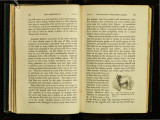
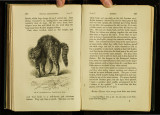
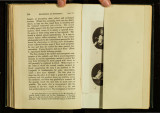
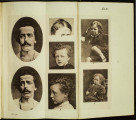
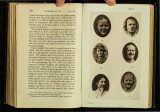
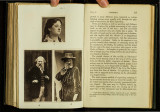
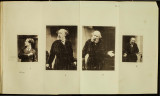
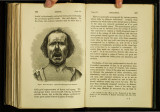
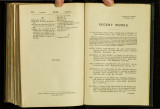
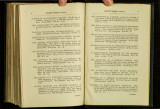
Show 272 HELPLESSNESS: CHAP. XL and will not sub1nit to some injury, holds his head erect, squares his shoulders, and expands his chest. He often clenches his fists, and puts one or both arms in the proper position for attack or defence, with the muscles of his limbs rigid. He frowns,-that is, he contracts and lowers his brows,-and, being determined, closes his Inouth. The actions and attitude of a helpless man nre, in every one of these respects, exactly the reverse. In Plate VI. we Inay imagine one of the figures on the left side to have just said, '' vVhat do you mean by " insulting me?'' and one of the figures on the right side to answer, "I really could not help it.'' The helpless man unconsciously eontracts the muscles of his forehead which are antagonistic to those that cause a frown, and thus raises his eyebrows; at the same ti1ne he relaxes the muscles about the n1outh, so that the lower jaw drops. ~rhe antithesis is co1nplete in every detail, not only in the movements of the features, but in the position of the limbs and in the attitude of the whole body, as may be seen in the accompanying plate. As the helpless or apologetic man often wishes to show his state of mind, he then acts in a conspicuous or demonstrative manner. In accordance with the fact that squaring the elbows and clenching the fists are gestures by no 1neans universal with the men of all races, when they feel indignant and are prepared to attack their enen1y, so it appears that a helpless or apologetic frame of mind is expressed in n1any parts of the world by Inerely shrugging the shoulders, without turning in wards the elbo,rs and opening the hands. The man or child who is obstinate, or one who is resigned to soine great mis· fortune, has in neither case any iqea of resistance by active n1eans ; and he expresses this state of mind, by simply kee.ping his shoulders raised; or he may possibly fold his arms across his breast. CnAr. xr. SIGNR OF AFFIRMATION, Errc. 273 . S igns of qffirmation o'r approval, and of negation m· d1sapproval: nodding ancl shaking the head.--I was eur~ous to ascertain how far the common signs usecl Ly ns In affirmation and negation were general throughout the world. These signs are indeed to a certain extent expressive of our feelings, as we give a vertical nod of approval with a smile to our children, when we approve of their conduct; and shake our heads laterally with a frown, when we disapprove. With infants, the first act of ~leninl ?onsists in refusing food; and I repeatedly n~t1ced ';'Ith m~ own infants, that they did so by Withdrawing their heads laterally from the breast, or fron1 anythin.g o~er.ed the~ in a spoon. In accepting food and tak1ng It Into their mouths, they incline their heads for"'ards. Since making these observations I have been jnfor1ned that the same idea had occurred to ?han~1a.17 It d~serves notice that in accepting or talnng food, there 1s only a single movement forward and a single nod implies an affinuation. On the othe;. hand, in ~·efnsing food, especially if it be pressed on then1, children frequently move their heads several titnes from side to side, as we do in shakin()' our heads in negation. Moreover, in the case of refus~l the head . ' 1:3 not rarely thrown backwards, or the mouth is closed, so tl:at these move1nents might likewise come to servo as Signs of negation. Mr. vV edgwood remarks on ibis subject/8 that "when the voice is exerted with closed " teeth or lips, it produces the sound of the letter n or "" m. H~ ~c~ we rna~ account for :he use of the particle ne to signify negation, and possibly also of the Gree] .. " fl/rJ in the same sense." " t· 'E . • ' i ssa1 sur le Langage,' 2nd edit. 1846. I am much indebted to l\f1ss Wedgwood for having given me this information with an extrnct from the work. ' 18 'On the Ol"igin of Lnnguagc,' 18G6, p. Dl. T |