| OCR Text |
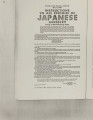
Show Keetley Farms 333 did it cause friction. In fact, Japanese converts had their own ward. The war and voluntary relocation brought Utah's attention to the so-called Japanese problem. Executive Order 9066 was popular around the country, and Utah was no exception. As historian Leonard Arrington has noted, Utah was not free from discrimination, but it did seem to have avoided the outright hostility that prevailed in California. 10 To Utahns Japanese Americans were "Japs," and while the local community was tolerated, newcomers from the coast were not particularly welcome. Individual Japanese, however, had been accepted and liked in the communities where they resided, and white residents regretted the impact of the war's dislocations on them. For example, the Park City Record noted on March 5, 1942, the suicide of one Ike Kow, who succumbed to carbon monoxide poisoning when he was dismissed from his job as a section foreman on the railroad, a position he, an Issei, had held for thirty-five years. The paper reported that he had left his automobile to his loyal housekeeper, and it commented that he was "held in high esteem by the railroad fraternity in Park City. " 11 Nevertheless, several thousand Japanese from the West Coast did come to Utah, either passing through on their way farther east or seeking homes here. Even though they met signs saying "No Japs Wanted Here," they persisted. Some got help from the Salt Lake Japanese community; other did not. 12 Of those who settled in Utah, the largest number joined the "Nihonmachi," or Japan town, of Salt Lake City, but it was the tiny settlement of Keetley, midway between Heber City and Park City in the Wasatch Mountains, that became a wartime home to the largest single group to resettle anywhere outside of the West Coast. Keetley itself was typical of the small towns that dotted the mining districts of Utah. It had begun as a mining shaft, the portage of a drainage tunnel from the Park City Mining District. When rancher George A. Fisher built a town at the site of the Park Utah mine in 1923, he named it after John B. (Jack) Keetley, the supervisor of the drain tunnel project and a former pony express rider. Fisher, appropriately enough, became Keetley's mayor. Life in the small settlement revolved around the mines, for the area was rich in silver, IO Arrington, " Utah's Ambiguous Reception." 11 Park City Record, March 5, 1942. 12 Helen Z. Papanikolas and Alice Kasai, "japanese Life in Utah," Peoples of Utah , ed. Helen Z. Papanikolas (Salt Lake City: Utah State Historical Society, 1976), p. ~5~ . |