| OCR Text |
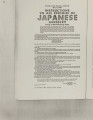
Show Keetley Farms 331 the Western Defense Command, Assistant Secretary of War John J. McCloy, provost marshal Maj. Gen. Allen W. Gullion, and Maj. Karl R. Bendetsen were the major villains of the piece, but it was President Franklin Delano Roosevelt who issued the infamous Executive Order 9066 which authorized relocation. The order was made public on February 20, 1942.5 Congress facilitated implementation, complementing the executive order with Public Law 503. De Witt carried out his task by excluding all people of Japanese origin, aliens and citizens, from the West Coast. At first they were ordered out of an extensive coastal strip deemed "prohibited." Many took refuge in interior communities, only to be ousted again. De Witt then proclaimed the existence of two extensive areas along the coast, Military Areas 1 and 2, which encompassed the western halves of Washington, Oregon, and California, and the southern half of Arizona. AI though no orders for mass evacuation were given at that time, the Western Defense Command encouraged Japanese to move from Military Area No. 1 and the California portion of Military Area No. 2. De Witt ordered Bendetsen to "employ all appropriate means to encourage voluntary migration."6 Thus, by the first week of March 1942 the stimulus had been provided for resettlement-with virtually no governmental machinery set in place to expedite it. The number of those who voluntarily sought to move has been determined by the change of address cards that were required of those leaving the two military areas after March 2. According to the findings of the Commission on Wartime Internment and Relocation of Civilians, 2,005 moved between March 2 and 27; and between March 27 and 29, when the voluntary phase ended, about 2,500 more cards were filed. De Witt said that although over 10,000 announced their intentions of moving, only 4,889 actually did. The commission found that of those, 1,963 went to Colorado (whose governor, William Carr, was unique in his hospitality to the unwelcome migrants.), 519 to Utah, 305 to Idaho, 208 to eastern Washington, and the rest elsewhere.7 However, for most such action was an impos- 5 Jacobus tenBroek, Edward N. Barnhart, and Floyd W. Matson, PreJudice, War, and the Constitution (Berkeley and Los Angeles: University of California Press, 1954), pp. 103-13. See also the Report of the Commission on Wartime and Internment of Civilians, Personal justice Denied (Washington, D.C.: Government Printing Office, 1982), pp. 93-94, 101-4. 6 U.S. Army, Western Defense Command and Fourth Army, Final Report: japanese Evacuation from the West Coast, 1942 (Washington: Government Printing Office, 1943), p. 41, as cited in tenBroek, Prejudice, p. 118. 7 Personal justice Denied, p. 104. |