| OCR Text |
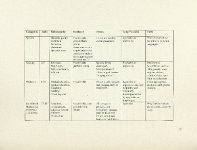
Show 25 The Appendix is organized according three distinct contributors: 1) oscillator, 2) filter and 3) lung function. The Appendix categorizes EVT production by beginning with vocal fold oscillators and moving through other oscillators. Each category includes very broad sonic possibilities as members of categories may be manipulated more specifically by filters, placements, registers, and by combining sounds from other categories. Where a category ends and another begins is determined by considerable deviation within any one of these contributors, as well as the technique's historical significance. For example, ululation could be considered a subcategory of speech or singing, but because the lung function is so unique to this technique, it warrants its own category. The most distinctive contributor to any vocal sound is the oscillator. The oscillator is the specific part of anatomy that actually vibrates to produce sound. In typical speech and singing, the primary oscillator is the vocal folds contained within the larynx. Secondary oscillators are used in speech and singing to create consonants, such as the tongue for a rolled "r" or the lips for a "p" sound. In addition to the vocal folds, extended vocal technique oscillators may include various parts of the tongue, the cheeks, lips, uvula, epiglottis, esophagus and extra-glottal windpipe sounds sources." Any single oscillator alone may produce a variety of sounds due to variations in tenseness of the involved anatomy and the amount of airflow being pushed (or pulled) through the anatomy. These variations in sound produced at and around the larynx will be labeled as different "phonations," and result in different sound bases (such as overpressure, forced blown sounds, fry, all to be discussed later) as well as variances in intensity and air efficiency (as can be noted in different singing techniques from various styles). 27 See the Appendix, glottal over-pressure/windpipe sounds (Audio examples 27- 28), and forced blown (Audio example 29). |