| OCR Text |
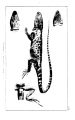
Show APPENDIX C.- REPTILES. 349 lower surface of the head alone seem not subjected to any serial order. Possessing only specimens that have been immersed in alcohol, and therefore have lost their general hue, we can only, in allusion to the colour, remark that the upper part of body and tail have transverse and irregular, sometimes undulating, and sometimes angularly broken bands of deep brown or black. Ten of these bands belong to the body from the occiput to the origin of the tail. On the tail itself they extend more or less toward the tip, accord* ing to the size of the specimen. This species inhabits Oregon, about the Dalles of the Columbia River, where it has been collected by Rev. George Geary. A specimen in our possession, from California, was collected by Colonel Fremont. That which is represented on our plate we owe to the kindness of Dr. Avery J. Skilton. PLESTIODON SKILTONIANUM, Baird and Girard. PL. IV. Fro. 4- 6. SFBO. CHAE.- Head small, continuous with the body; tail stout, rery long, and subquadrangular; olivaceous brown, with four broad bands of black. This is a species of skink which must strike any one familiar with the general appearance of the other species of the same genus inhabiting North America. The tail, although considerably developed in all the skinks of the genus Plestiodon, acquires in this species much greater proportions. In the specimen figured, the tip of that organ is wanting, but when restored, the whole organ would be nearly twice the length of the rest of the body and head. Its form is rather subquadrangular than conical, and preserves a general stoutness which is not seen in the other species, in which it tapers more suddenly from its origin to its tip. The body is subcylindrical, and nearly of the same thickness from the occiput to the tail, into which it passes almost imperceptibly. The head itself is rather small, subcorneal, rounded on the snout; it is continuous with the body, the neck being but slightly contracted. The plates of its upper surface are represented in figure 6, which will serve as a good term for comparison with the other species. The locomotive members are very short; the fore ones rather slender, the hind ones stouter. The toes are terminated by delicate and slender nails, curved' at their tip. The scales have a very smooth appearance; when examined attentively, those of the |