| OCR Text |
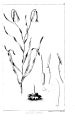
Show SILK PLANT- SPRING BAT. 175 Both are of a very close texture, and would make excellent building- stone. Around the springs was found, growing in considerable quantity, a plant I had not before seen- called by some of the men silk-plant. It somewhat resembles the sumac in appearance, and has at its top a cluster of long slender pods, which, nhen ripe, split open longitudinally, disclosing a number of seeds, each attached to a fascicle of long silky fibres, resembling very fine threads of spun glass. The bark is tough, strong, and very much like that of flax. The root and the plant, when broken, exudes a milky viscous substance- that from the root is intensely bitter. The Ottoes and Omahas make lariats of the bark, which are said to be stronger and better than those made of hide. It is said to grow abundantly near Council Bluffs, in Missouri. My Frenchman called it vache d lait. The Mexican negro cook calls it capote des acarte. He says that the Pueblo Indians call it noche. They cut it down when ripe, rub it so as to separate ther fibres, and make of it beautiful and very strong fishing- lines and fine sewing- thread. They also use a decoction of the root for medicinal purposes- the root itself is put into liquor to make bitters. Beyond these springs the lake makes a wide, deep bay, stretching far to the northward, near the head of which the promontory range bounding it on the east seems to sink away. On the west, the bay is bounded by a low range of rocky hills, stretching to the north. Between these hills the country is much lower, and ascends northwardly, by a gentle rise, to a belt of low hills far off in the distance; over which, farther to the north- west, is seen a range of snow- capped mountains. Starting from the springs with the boats, we attempted to make our way to the point where the eastern range seemed to terminate; but found the water so shallow that it was impracticable. After many fruitless attempts, the boat was brought as near the shore as possible, part of the baggage loaded into the skiff, and pushed toward the land. It was impossible, however, to bring even this light barque nearer than within a quarter of a mile of the beach, and the luggage was transported to shore on our shoulders. On landing, we found ourselves on the margin of an immense flat of sand, destitute of the least sign of vegetation, and only a few inches above the level of the water, which covers a large portion of it whenever a fresh wind prevails from the south. It stretches across the head of the bay from near the springs to the southern |