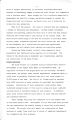
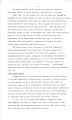
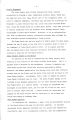
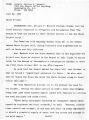
| Title |
Dixie Project legislation, 1963-1964 |
| Description |
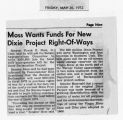
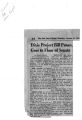
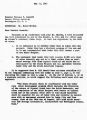
Papers, correspondence, news articles, and text of Congressional bills about the Dixie Project, southwestern Utah |
| Subject |
Dixie Project; Water-supply--Utah--Washington County; Water resources development--Utah--Washington County; Irrigation--Utah--Washington County;Water-supply--Utah--Iron County; Water-supply--Utah--Cedar City |
| Contributor |
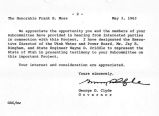
Clyde, George Dewey, 1898-1972; Bingham, Jay R.; Beasley, D. Otis; Bennett, Wallace F. (Wallace Foster), 1898- ; Carter, Luther J. |
| Additional Information |
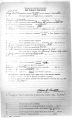
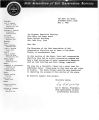
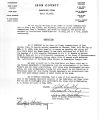
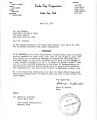
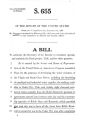
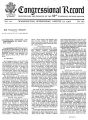
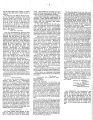
Includes: Newspaper articles on Dixie Project, 1963-1964; Copies of 1953 agreements on use of Kolob Reservoir water; Applications for diversion of Crystal Creek; Congressional Record text of House bill H.R. 3279 and Senate bills S. 26 (from 1961 by Frank Moss) and 655 (from 1963 by W.F. Bennett); Statements of support from Utah Gov. George D. Clyde; Jary R. Bingham (Director of Utah Water and Power Board), Senator Wallace F. Bennett and others; 88th Congress, 2d session, House of Representatives report no. 1725, "Dixie Project, Utah, Report to accompany H.R. 3279" by D. Otis Beasley, Asst. Sec. of Interior; and final legislation, Pub. Law 88-565, approved Sept. 2, 1964, "An act to authorize the Secretary of the Interior to construct, operate, and maintain the Dixie project, Utah, and for other purposes." Also includes article, "Grand Canyon: Colorado dams debated," by Luther J. Carter, fromScience vol. 152 (17 June 1966), p. 1600-1605 |
| Spatial Coverage |
Crystal Creek (Utah); Kolob Creek (Utah); Kolob Reservoir (Utah); Virgin River Basin; Santa Clara River (Utah); Washington County (Utah) |
| Collection Number and Name |
Accn0823 bx 30 fd 8; ; John S. Boyden papers |
| Rights Management |
Digital Image Copyright 2009, University of Utah. All Rights Reserved. |
| Holding Institution |
J. Willard Marriott Library, University of Utah |
| Date |
1953; 1961; 1963; 1964; 1966 |
| Digitization Specifications |
Original scanned on Epson Expression 10000 XL and saved as 400 ppi TIFF. Display image generated in CONTENTdm. |
| Publisher |
Digitized by J. Willard Marriott Library, University of Utah |
| Type |
Text |
| ARK |
ark:/87278/s61835g2 |
| Setname |
wwdl_neh |
| ID |
1148037 |
| Reference URL |
https://collections.lib.utah.edu/ark:/87278/s61835g2 |
| Title |
Page 64 |
| Setname |
wwdl_neh |
| ID |
1148007 |
| OCR Text |
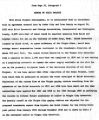
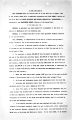
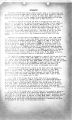
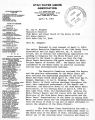
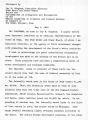
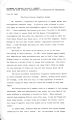
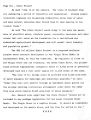
Show STATEMENT BY SENATOR WALLACE F. BENNETT BEFORE THE HOUSE INTERIOR SUBCOMMITTEE ON IRRIGATION AND RECLAMATION June 22, 1964 The Dixie Project-Urgently Needed Mr. Chairman, I appreciate the opportunity to appear before this distinguished committee today. It gives me great pleasure to voice once again my complete and enthusiastic support of the Dixie Project Bill. I have supported the project ever since I arrived in the Senate in 1951-first to secure funds for the Bureau of Reclamation's investigation and then after the completion of the study to offer the first Dixie Project bill which was S. 14 in the 87th Congress. Senate passage of the bill last October marked a significant milestone for Dixie. I hope the House may hurry the Dixie Project along to final action this year. The story of the Dixie Cotton Mission is one of the most fascinating in Utah's history. In 1861, three hundred wagons loaded with families and their provisions were sent by Utah's first leader. Brigham Young, to colonize the area and to plant and raise cotton for the State in a valiant effort to become self-sustaining. The cotton industry was short-lived, however; and today Utah's Dixie is unique for the varieties of fruits and nuts and farm produce which can be grown there when water is available. The early colonizers initiated an irrigation system which opened up these croplands and fruit orchards. However, without river control and storage, it was then and still is today impossible to divert a plentiful supply of water from the rivers and streams in this arid region. The Dixie Project will someday stand as a monument to the courage, heartbreak, faith and determination that marked the long fight of the early settlers to establish a foothold in Dixie. These pioneers exerted back-breaking efforts, year after year, to dam the Virgin and Santa Clara Rivers, to plant crops and irrigate the fields, only to have these irrigation facilities washed out by floods and the crops wither. In modern days, southern Utah has suffered from severe drought conditions for well over a decade. Yet, the watershed of the Virgin |
| Reference URL |
https://collections.lib.utah.edu/ark:/87278/s61835g2/1148007 |