| OCR Text |
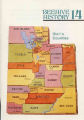
Show Utah's Counties - I N 29 Unique Parts - Max J. Evans of One State Stanford J. Layton Coordinator of Publications Miriam 6. Murphy Beehive History Editor O Copyright 1988b Utah State Historical Soclety 300 RIO Grande Contributors Cralg Fuller Stanford J. Layton Murray M. Moler Mlrlam B. Murphy Phllip F. Notarlann~ Gary B. Peterson I * * Cherie Hale, cover + La Mar W. Lindsay, as state archaeolog~ st Susan4Whetstone, photogra Th~ s" ublicat~ on has beeh funded with ! hee assisiapce of a matchlng grant- ln- atd from the Department o I I the , Interlor, Natlonal Park Service, under pr of the Natlonal Htstorlc Preservation Act of 19 amended a a Thls program recelves flnanclal assistance for iden- In 1850 the Utah Territorial Legislature created six small counties. Each contained an area of early white settlement. County borders and names were changed about 100 times be-fore the creation of Daggett County in 1917 gave Utah its present 29 counties. Counties are units of local government, but state laws define their form and powers. Three-member county commissions govern 28 of Utah's counties. In 1987 Cache County changed to another form of government allowed under state law and is now run by an executive officer and a seven- member council. The commission or council must hold regular meetings, open to the public, at the county seat. Other elected offi-cials usually include county clerk, treasurer, at-torney, recorder, assessor, auditor, surveyor, and sheriff. In the early settlement period, county and town officials were often LDS church leaders. Counties may do many things. Like all units of government they raise money to operate by taxes, fees and licenses, fines, and when ap-proved by the voters, bonds. Counties may license and regulate local businesses, zone prop-erty and plan development, build and maintain roads, and build and operate a variety of facili-ties including schools, libraries, jails, hospitals, fire departments, senior citizens centers, air-ports, golf courses, parks, zoos, and plan-etariums. Counties issue marriage licenses and record property ownership. They may also pro-vide such services as water. waste dis~ osale, lec-tric power, flood control, welfare, and animal control. Probate courts operated in each county until statehood and from 1852 to 1874, when federal law banned the practice, they often heard civil and criminal cases as well as probate matters ( wills and estates). In 1896 the new state constitution created seven multi- county judicial districts. A district REDUCTIONS OF UTAH TERRITORY C - CACHE M - MORGAN CE - CEDAR R - RICH D - DAVIS S - SUMMIT GW - GREASEWOOD W - WEBER UTAH'S COUNTIES 1860 court must meet at least three times a year in each county seat within the district. Counties also have justice- of- the- peace courts where cases involving violations of county ordinances are heard. About three- fourths of Utah's land is owned by federal, state, or local government. This has profoundly affected the development of almost every county. Government is the leading em-ployer in two- thirds of Utah's counties and number two or three in the others. In the early 1970s Utah's counties formed voluntary, multi- county associations of govern-ment. Seven such regional associations pres-ently operate in Utah to deal with planning is-sues and problems that transcend county boundaries, especially in the areas of health, so-cial services, and ecouomic development. Utah's counties vary greatly in geography and geology, in area and population, and in nat-ural resources and economic development. Each has its unique features and- history. Yet, each is part of a whole - the state of Utah - and shares a common heritage. Part of that heritage is, of course, he original occupation of the land by prehistoric Indian cultures and his-toric Indian groups and, later, the distinctive mid- 19th century settlement by whites under the direction of leaders of the Church of Jesus Christ of Latter- day Saints. Mining, railroading, industrial and business development, and im-migration - especially by Europeans, Mexi-cans, Asians, and Blacks - have diversified the ethnic and religious mix. The capsule histories that follow present some of the unique qualities of each county. |