| OCR Text |
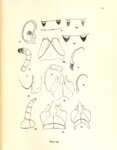
Show a· 45 of legs; the coxae of the toxicognaths in front non-toothed; the coxae one bisulcate; the first from legs extend only unto the last stigma; terga antennae long 7 Megethmus pluripes Chamberlin. 45 pairs of legs; the sternum of the last leg-bearing segment broad, strongly 2 narrowed posteriorly, truncate at caudal end ........•..•............ Mecistocephalus nannocricus Chamberlin. 6 49 pairs of legs 7 Sternal impressions forked ..•........•........................ Sternal impressions never forked, at most short, rudimentary branches present; 3 the coxae of last legs with numerous pores; nine pectinate lamellae Mecistocephalus rubriceps Wood. 8 The forks of sternal impressions obtusely angled The forks of sternal impressions acutely angled; (the basal shield on the anterior ends with a swelling which projected in the middle. The last legs strongly haired; at the depression of head shield on four pits; antennae short; head small; on the 4 ungulum of toxicognaths a sharp plate-like curved tooth Mecistocephalus curvidens Haase. The teeth of each pectinate lamella are on the base not much s mailer than those on the ends; (the pleurae of the head setose to the level of the labrum; anterior clypeus shorter than the posterior clypeus) 5 Mecistocephalus maxillaris Gervais. The teeth of each pectinate lamella are in the proximal half much smaller than those in the distal half 6 Mecistocephalus philippinus Chamberlin. 4b. 97 pairs of the last ....•.•.•. 5a. · 5b. . 6a. . . . • . . . . . . . . . . . . . . . . . . . . . . . . . . . . . . . . • . • 6b. . 7a. . • . . 8a. . . . • . . . • . . ..•......•.......... 7b. . · • • • • . ..... 8b. .....•. Family Oryidae Cook 1895 Cook, Arrangement of Geophi. Proc. U. S. N. Mus., 18, p. 65, 66. Subfamily Oryinae Brolemann 1909 Arch. Zool. Exp. Gen., (5) III, p. 309. 1895 Family Oryidae Orphnaeus Meinert 1870 is represented in the Philippine Islands and its identifi key. One species, Q. brevilabiatus, is found and our specimens variations from this species. 1. The genus Orphnaeus cation is given in the above show some Genus (Meinert) 1. Orphnaeus brevilabiatus (Newport) Figs. 1-4. 1844 Geophilus brevilabiatus Newport, Trans. Linn. Soc. London, 19, p. 43.6. This widespread species is represented by ,1 7 specimens: 11 females and 1 male from Los Banos, Luzon; 3 females and 2 males from Mindanao; Philippines. All are in Dr. Chamberlin's collection, University of Utah. (P. I. No. 188-204). These Philippine specimens have 2 or 3 pectinate lamellae on the mandible instead of 4 or 5 of the typical ones. The pairs of legs vary in females from 75 to 83, in males from 75 to 79, but most of females have 81 pairs of legs. The single male from Los Banos has the uropods much thicker than those of others. total length, females from 35 to 76 mm., males from 33 to 41 mm.; from .7 to 1 mm., males about. 7 to .8 mm.; length of head, females from .5 to 1 mm., males about .5 mm.; width of head, females from .4 to .8 mm., males about .4 mm.; length of anal segment, females from .3 to .6 mm., males about .3 mm.; width of anal Their measurements: width, females segment, females from .2 to .4 mm.; males from .2 to .3 mm.; length of antennae, females from 1 to 1.8 mm., males about 1 mm. extending only to the second segment; length of uropods, females from .3 to .8 mm., males about .6 mm. Family Mecistocephalidae Verhoeff Subfamily Mecistocephalinae Verhoeff, Beitr. Z. K. Pal. Myr., 16. 1908 Fam. Mecistocephalidae Verhoeff, Bronn's Class U. Ord., p. 271. One subfamily, Mecistocephalinae, is represented in the Philippine Islands. 1901 |