| OCR Text |
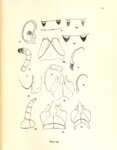
Show 14 Two species have been recorded by Pocock and Chamberlin from the Philippine Islands. Castanotherium leium Chamberlin. Fig. 1-11. 1921 Annals & Mag Nat. Hist. Ser. 9. vol. 7, pp. 60-61. I examined nine specimens of this species and agree fully with the original this species by Dr. Chamberlin. 3. .. Holotype locality: Philippines: Luzon, Mt. Makiling (C. F. Baker). Type, description of Mus. Com. Zool. No. 4690. plesiotype: In the anterior gonopods the movable finger is longer than the oter one, and with seven stridulating pits on dorsal surface, the immovable one shorter and thicker, is more In the posterior gonopods, the two fingers are sub-equal in length, the movable one slender and double concave internally, with stridulating organs on internal posterior edge. Ocelli from 51 to 67 in number and in 9 to 13 rows, mostly 55 in number and in 11 rows. Sense cones on the antennae, from 24 in 7 rows to 87 in 15 rows. Their measurements: (1) total length of body, from 19 mm. to 41 mm., average 27.2 mm.; (2) length of head, from 3 mm. to 6 mm., average 4.15 mm.; (3) width of head, from 4 mm. to The male 8 mm., average 5.83 mm.; (4) length of collum, from 2 mm. to 4 mm., average 2.6 mm.; (5) width of collum, from 5.5 mm. to 10.5 mm., average 7 mm.; (6) length of the second plate, from 2 mm. to 6 mm., average 3.5 mm.; (7) width of the second plate, from 9 mm. to 26 mm., average 15 mm.; (8) length of the pygidium, from 6.5 mm. to 16 mm., average 10.16 mm.; (9) width of the pygidium, from 11 mm. to 29 mm., average 18.4 mm.; (10) length of the antennae, from 3 mm. to 6 mm., average 4.25 mm.; those of one specimen are lost; (11) length of the first pair of legs, from 4 mm. to 9 mm., average 6 mm. . Locality: Philippines: 1 male each from Mt. Makiling, Luzon; Sungao, Mindanao; and Zam boanga (C. F. Baker); five females and 1 male from Samar (P. Bartsch). All the plesiotypes in Dr. Chamberlin's collection, University of Utah. (Nos. P. I. 7, 8, 9, 10, 11, 21-24.) The immature form shows the following differences from the adult: (1) no stridulating or gans on the gonopods of the young; (2) stipes without middle tactile bristles; (3) lamellae lingualis without inner tactile bristles; (4) there is an inverted W-shaped ridge on lamella lingualis. 4. Castanotherium hirsutellum Pocock. 16: 414 Locality: Paragua, Palawan. No specimens were found in this collection, and Pocock's diagnosis is be wholly certain of its relation to C. leuim of Chamberlin. 1895 Ann. Nat. Hist. (6) so brief that I cannot 4. Genus CaStinotheroides Chamberlin 1921 Annals and Mag. Nat. Hist. Sere 9, vol. 7, p. 61. This genus differs from Castanotherium in lacking the characteristic enlargement of the last antennal article, the latter being simply cylindrical and bearing only four sensory cones instead of numerous ones. Generotype: Castanotheroides porosus (Pocock) 5. Castanotheroides porosus (Pocock) 1895 Castanotherium porosum Pocock, Ann. Nat. Hist. (6) 16. 1921 Castanotheroides porosus Ibid. Chamberlin, The anterior gonopods without stridulating organs; the last antennal article not enlarged and only four sense cones. No specimen is found in the University collection. Locality: Philippine Islands. 5. Genus Luzonosphaera New Femur of the posterior gonopods without keels. Prefemur of the anterior gonopods without stridulating organs in the shape of keels and no large process, its immovable finger being with |