| OCR Text |
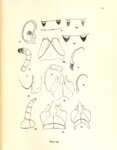
Show 28 Male with tarsal pads on all legs. Anal scutum very short, without transverse furrOw. some The ventral plate of anterior gonopods broad, the epical portion abruptly narrower what widened at the middle. The basal of the posterior gonopods is smaller than that of Acladocricus philippinus, the portion generotype. Body segments 56 in number. Only one male is found in this collection, its measurements being as follows: total length, 276 mm.; the length of head, 9 mm.; breadth of head 18 mm.; length of collum, 9.5 mrn.; breadth of collum, 26 mm.; length of second plate, 5 mm.; breadth of second plate, 34 mm.; le,ngth of of legs, cauda, 6 mm.; breadth of cauda, 24 mm.; length of antennae, 7 mm.; length of first parr 8mm. Locality: Loquilocou, Samar, Philippine Islands, June 1924, collector unknown. Type: one male holotype (P.l. No. 129) is in Dr. Chamberlin's collection, Institute Arachnology and Myriapodology, University of utah. 35. of Acladocricus sp. N. Sp. Fig. 108 This form in the lack of male , cannot be referred to a species with certainty. It resembles preceding species. The coloration is more regular than that of the A. major, no much the metallcally. preceding species as follows: The head, no depression along the sulcus in the areas between antennae; number of sensory cones 39 in 9 rows; number of ocelli 33 in 6 rows; the dorsum smooth throughout, no coriaceous striae and punctures, the scobina tri angular in outline and larger. The body segments are 60 in number, the collum the longest and narrowest; the second plate the shortest; the tergites at the mid-body region the broadest. Only one female was found, its measurements being as follows: total length, 220 mm.; length of head, 8 mm.; breadth of head, 16 mm.; length of collum, 9 mm.; breadth of collum, 20 mm.; length of second plate, 4.5 mm.; breadth of second plate 29 mm.; length of cauda, 6 mm.; breadth of cauda, 23 mm.; length of antennae, 7 mm.; length of first pair of legs, 8 mm. Locality: Dumagueto, Philippine Islands (J. P. Chapman, no date). Type: one female holotype (P.1. No. 130) is in Dr. Chamberlin's collection, University of slightly lighter area on dorsum and shines It differs from the Utah. 2. Superfamily Atopetholoidei N. Name The second tergite not produced below the level of the end of the collum. The collum nar rowed laterally or acute. Scobina absent. The repugnatorial pores on prozonite. The posterior gonopods independent, without sternite. The tracheal stalks lie in the same axis as the gonopods. The gonopods are not articulated to a strongly developed basal support as present in all members of the Spiroboloidei. In the basal segment no vesicles such as present in all members of the Trigoniuloidei but having a separate basal segment set off by a definite suture or joint somewhat as in the latter group. The posterior gonopods as a whole one compact piece. The anterior gonopods with the coxae broad, the ventral plate lower and narrow. One family was created by Dr. Chamberlin in 1918 and he contributed many genera and spe cies, all of them North American. In this collection from the Philippine Islands, several speci mens were found conforming to this family but representing a new genus and extending the such are geographical range of the 1918 Atopetholidae Only one genus and family. Family, Atopetholidae Chamberlin, one Chamberlin Washington 31:167. Philippine Islands and new Proc. Biol, Soc. species found in the to science. 15. Genus Banosolus, New This genus agrees with members of the family Atopetholidae in general, especially in the structure of the posterior gonopods. But the size is larger, the collum is less acute' laterally, |