| OCR Text |
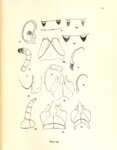
Show 34 1. Spirostrophus socius socius Chamberlin. General color reddish-brown. The principal branch of gonopods distally trilobed. (Fig. 124). Body segm-ents 53 to 55; number of ocelli 34. in 6 rows. Body length 41 to 43 mm.; diameter 9 mm.; length of head plate about 3 mm.; width about 6 mm.; length of collum 2.5 about mm.; width 7 mm.; length of antennae about 300m.; length of cauda about 2 mm.; width 6oom. Locality: Philippines; Los Banos (C. F. Baker). Types: P. I. No. 1-3, 2 females and 1 male in the collections . of Dr. . Chamberlin, UnIVerslty of Utah. 2. Spirostrophus socius samarus, New Variety. General coloration from brown to darker, the annulation is foregoing variety but not so much as in the following one. The gonopods two lobed distad, the inner one the larger. Body segments 51 to 54, mostly 52 and 53. Ocelli 35 more conspicuous than principal branch of the to 42 in 6 to 7 rows. in the posterior Body length from about 31 to 85 mm., diameter from 6 to 12 mm.; length of head from 2 to 4 mm.; width about 4 to 7 mm.; length of collum from 2 to 3 mm.; width about 5 to 9 mm.; length of cauda from about 1 to 2.5 mm.; its width from about 3 to 7 mm.; length of antennae from 1.5 to 3 mm. from Samar, (P. I. No. 73); paratypes: 1 female from Mindanao Locality: 1 male holotype (Baker, P. I. No. 1 female from No. 186); 63 90), 7 females and 4 males from Los Banos (P. I. No. 112-122); 3 males and I. No. 124-126); 1 male from Samar taken at Hawaii (P. I. locality unknown (P. females and 28 males from Los Banos, (specimens unnumbered). in Dr. Chamberlin's collection, University of Utah. Types and specimens all 3. Spirostrophus Color rings socius mindanao nus, New Variety. distinct than in the foregoing two varieties. The more principal branch of posterior gonopods distally (Fig. 126). Body segments 53 and 54. Ocelli 33 to 39 in 6 rows. Body length from 30 to 64 mm., diameter 6 to 10 mm. Locality: 1 male holotype and 1 female allotype from Mindanao (P. I. Nos. 94, 95); 2 fe males and 1 male paratype from Mindanao (P. 1. Nos. 96-98); 1 female paratype from Duma dentate guete (J. W. Chapman, P. 1. No. 99); 7 females from Manila taken at Hawaii, 19 April, 1947 (P. I. Nos. 175-181); 10 females from Manila taken at quarantine, Hawaii (P. I. Nos. 165-174). Types: All the types are in Dr. Chamberlin's collection, University of utah. 19. Genus Variulus, New This genus is undoubtedly close to Sympastrophus Chamberlin with which it agrees in hav ing the ventral plate of the anterior gonopods distally deeply incised and a conspicuous process extended by the femur of the telopodite; but it differs in having three joints proximal of the tarsi of the legs padded. In the posterior gonopods the ordinary proximally there is a broad process. Generotype: Variulus mindanaonus N. Sp. 46. processes are bilobed and Variulus mindanaonus N. Sp. Figs. 115-120 Color in general reddish-brown, the caudal borders of metazonites brighter red. Antennae legs flavous. Head smooth; median sulcus present over vertex and clypeal region but absent from frontal region. Eyes large, subtriangular with the three borders all straight, number of ocelli 42 in and 7 rows. Collum smooth, anterior border margined, the inferior subrectangular. (Fig. 118). tergites, punctae present dorsum, longitudinal striae below the pore present on both rings; transverse sulcus very distinct; no transversal striae, no markings on the covered region of prozonites. On other on corner |