| OCR Text |
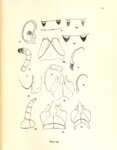
Show 15 formed by a process of the femur. Vulva consisting of two the operculum, is not divided and the proximal portion, the The shield without anterior declivity. Tergites without as a short cylinder bearing four sense Generotype: Luzonosphaera philippina N. Sp. antennae observable of Zool, This genus seems much to resemble Castanotherium but the latter has numerous sense The coloration of the generotype is like that of Zygethomeris lamprus Chamberlin. Luzonosphaera philippina Fig. 12-20. N. Sp. The color is chocolate brown with the borders orange or yellowish. Head light brown; the collum brown; antennae, legs and ventral part fulvous. The head punctate, the punctae setigerous; concave above at the middle. Eyes showing 'S, nm,; ! (0) Dnn., am' Ir' cones. cones. 6. In, pieces, of which the distal portion, bursa, is also not divided. spines. The seventh article of the brilliantly within a dark area, composed of 26-28 ocelli in 9 rows. Antennae composed of 7 joints, with the sixth the longest. The collum has the anterior edge at middle curved ventrad to fit the concavity of the head. Somewhat finely punctate and setigerous, with one large and one small black densely setigerous area near each angle; black dotted over the middle. The second plate margined anteriorly and laterally and ridged anteriorly; closely punctate. Other tergites closely punctate and the anterior half with black dots. The pygidium punctate; showing secondary sexual characteristic in that in the male the cau dal border bears a small projection on the middle. (Figs. 14 and 15). Legs usually with one spine above the claw and four to six spines below it. The vulva is composed of two pieces, the distal portion, the operculum very large, sur mounting the proximal portion and shaped somewhat like a rounded triangle. The proximal portion, the bursa, is smaller than the operculum, somewhat subrectangular. The genital open ing is wide, elliptical and shows a sclerotized piece on the left wall. (Fig. 16). The third telopodite, the tibiotarsus, of the anterior gonopods smaller and shorter than the others, with a series of five to seven stridulatory organs, abruptly and slightly bent distally toward the second telopodite. In the second telopodite, the femur is the largest and bears an internal process. (Figs. 17 and 18). In the posterior gonods, both fingers are concave internally and slightly bent distally. The immovable finger is longer, blunted and hirsute distally. The movable finger, the tibiotarsus, is short and pointed and bears a series of stridulation organs more than ten in number. (Figs. 19 and 20.) Their measurements: (1) total length, males 33 to 45 mm., female 44 mm.; (2) length of head, males 3 to 4 mm., female 4 mm.; (3) width of head, males 5.5 to 6 mm., females 6 mm.; (4) length of collum, males 2 to 2.5 mm., females 2.5 mm.; (5) width of collum, males 5.5 to 6 mm., females 6 mm.; (6) length of the second plate, males 3.5 mm. to 4 mm., females 4 mm.; (7) width of the second plate, males and females 17 mm.; (8) length of pygidium, males 7 to 7.5 mm., females 7 mm.; (9) width of pygidium, males and females 17 mm.; (10) length of antennae, males 2.5 to 3.5 mm., females 3.5 mm.; (11) length of the first pair of walking legs, males 4 to 4.5 mm., females 4.5 mm. Locality: Two males and one female from Mt. Makiling, Luzon, Philippines (C. F. Baker). Types: One male holotype (P. I. No.5), one male paratype (P. I. No.4) and one female allo type (P. I. No.6) all in Dr. Chamberlin's collection, University of Utah. 2. One Suborder Glomeridioidei Brandt 1833 species, Zygethomeris lamprus Chamberlin, from Borneo, which belongs to the family sub-family Glomerinae, is also represented in this collection from the Philip Glomeridae and pine Islands. Family Glomeridae Pocock Subfamily Glomerinae Latzel 1884 6. Genus Zyge'thomeris Chamberlin |