| OCR Text |
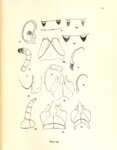
Show 20 borders In other tergi tea the angles of the keels are strongly produced caudad. The lateral trans of the keels a to fifth inclusive with from eighteenth strongly thickened. All tergites to verse sulcus. Tergites showing also a much finer median longitudinal line at right angles less the transverse sulcus. The surface of the tergites between keels coriariously more or roughened. There are four pits before the transverse sulcus. (Fig. 57}. Cauda rounded, tubercles small. Anal sternite rhomboidal. Anal valves strongly margmed, longer than broad. (Figs. 55-56). The telopodite of the male gonopods appears somewhat like that of R. montanus, but the branch which bears the sper-matic canal bends in direction against the forked one and as a whole is not so much bowed. (Fig. 54). Locality: Philippines: Mindanao (Baker). Type: one male holotype (P.I. No. 34) in Dr. Chamberlin's collection. Its measurements are as follows: total length, 44 mm.; length of head, 4 0000.; width of head, 5 mm.; length of 3 width of collum, 5.5 mm.; length of second plate, 2.5 mm.; width of second collum, mm.; 2 mm.; length of antennae, 6 mm.; 5.5 plate, mm.; length of pygidium, 3 mm.; width of pygidium, of first 4 of mm. length pair legs, 17. Prionopeltis infulatus N. Sp. Figs. 59-62 Head and collum deep brown; antennae light brown; prozonites deep brown; metazonites in front of transverse sulcus deep brown, those behind the sulcus and the keels bright yellow, somewhat whitish; legs light brown; sternites somewhat whitish. A distinct sulcus present on the head, this forked below and sending a branch to the edge of each antennal socket. Anterior margin of collum straight between the lateral angles. Cau dal margin bowed, the lateral angles of the keels very slightly produced. In other tergites the angles of keels are moderately produced to the 14th somite; the fif teenth tergite with the angles strongly produced. The lateral borders of keels thickened. A transverse sulcus and a mid-dorsal line present but these fine and obscure. The surface of tergites between keels slightly coriarious and tubercular. (Fig. 62). Cauda rounded, with a prominent tubercle on each side of the caudal end. Anal valves strongly margined. Anal scale convexly rounded caudally. (Fig. 60-61). In the telopodite of the gonopods the two distal branches are slender and finely acute, each toward its distal and bending directly ectad. The gonopods as a whole are rather straight. (Fig. 59). Locality: Philippines: Mindanao (Baker). Type: One male holotype (P. I. No. 46) in Dr. Chamberlin's collection is examined. Its measurements are as follows: total length, about 39 mm.; length of head, about 4 mm.; width of head, about 5 mm.; length of collum about 3 mm.; width of collum about 5 mm.; length of second plate, about 2 mm.; width of second plate, about 5.5 mm.; length of pygidium, about 3 mm.; width of pygidium about 2 mm.; the length of first pair of legs, about 3.5 mm. Family Platyrhachidae Pocock 1895 One genus and seven species are known from the Philippine Islands. . 12. Genus Platyrhacus Koch 1847 Platyrhacus Koch, System der Myriopoden. Generotype: Platyrhacus seaber Koch. New generotype: Platyrhacus pfeiferae Humber & Sauss. Platyrhacus in the broad sense is adopted by Attems and Chamberlin. There are seven known species of this genus represented in the Philippine Islands. Among them two are new. |