| OCR Text |
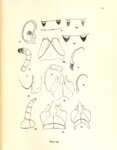
Show 31 length, male 57 mm.; 4 females from 38 to 74 mm.; length of head, male 3 of head, male mm., females from 2.5 to 3.5 mm.; breadth 2.5 to 3 mm.; 5 mm., females from 3 to 5 from females 3 male of mm., collum, mm.; length male 1 mm., breadth of collum, male 6.5 second of 4-7 from females plate, length mm.; mm., females a little more or less than 1 mm.; breadth of second plate, male 7;5 mm., females from 5 to 8 mm.; length of cauda, male 2.5 mm., females from 2 to 3 mm.; breadth of cauda, male to 3 mm.; 6 mm., females from 4-6 mm.; length of antennae, male 2.5 mm., females from 1.5 length of first pair of legs, male 2 mm., females 1 to 2 mm. This form might prove to be a distinct variety and could be designated as !'. philippinus Measurements based upon plesiotypes: total negro. 39. Trigoniulus melanotelus Chamberlin Figs. 112-114. 1921 Annals & Magazine of Nat. Hist.Ser. 9, Vol. 7, p. 70. Locality: Philippines; Luzon, Mt. Makiling. (C. F. Baker). Types: holotype M.C.Z. (No. 4780); paratypes (No. 4781); plesiotypes 2 males each from Dumaguete (No. P.I. 100, 101, J. W. Chapman) and from Mindanao (No. P.I. 89, 103, collector unknown) in Dr. Chamberlin's collection, University of Utah. Measurements: total length, males from 54 to 80 mm.; length of head, males from 2.5 to 4 mm.; breadth of head, males from 4.5 to 6 mm.; length of collum, males from 2 to 2.5 mm.; breadth of collum, males from 5.5 to 7 mm.; length of second tergites, males from .8 to 1.5 mm.; breadth of second tergites, males from 5.5 to 7 mm.; length of cauda, males from 1.5 to 2.5 mm.; breadth of cauda, males from 5 to 6 mm.; length of antennae: P. I. No. 100, 3 mm. in length, those of other specimens destroyed; length of first pair of legs, males from 1.5 to 2 mm. The plesiotypes show some variations from the holotype. 40. Trigoniulus major ChamberlinMagazine of Nat. Hist. Sere 9, Vol. VII, p. 71. Locality: Philippines: Luzon, Mt. Makiling, (C. F. Baker). The holotype, a female is at Mus. Compo Zool. (No. 4814). No specimens 1921 Annals & of this species were found in the Chamberlin collection. 41. Trigoniulus laminifer, N. Sp. Figs. 98-105 This species differs from other Trigoniuli found in the Philippine Islands and the wide spread !. lumbricinus (Gerst.) in size and in details of the gonopods. Prozonites reddish-brown, metazonites flavous on dorsum gradually darker down the sides. Head light brown, the clypeal region lighter. Antennae and collum light brown. Anal scutum with anterior half darker while the caudal half is lighter brown. Valves lighter, the margin flavous. Legs yellowish. Head smooth; median sulcus present on vertex and clypeal region but absent at front. Eyes roundish-triangular, the external ocelli enlarged, caudal border convex, the other two sides straight. Antennae elongate, their joints sub equal in length, except the basal one which is shorter. (Fig. 98). Collum margined laterally; narrowed down the sides as usual, 103). (Figs. Segmental sulci very fine. Transverse lines densely arranged below the pore on the pro zonites, those only present above on the covered region of segments, so that the dorsum ap pears smooth. Longitudinal striae present on the metazonites on each side below the pore. Anal scutum -with caudal angle rounded, free of striae, but with a transverse depression setting off the cauda, not surpassing the valves. (Figs. 104-105). Legs elongate, singly spined; tarsal cushions present in male but absent from the last fif smooth, its anterior border the lower end rounded. teen segments. (Fig. 99). 101 and I 'I |