| OCR Text |
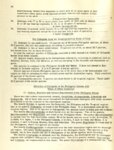
Show I. INTRODUCTION The Problem investigation of which the results are recorded in this report was to determine as far possible the character of the myriopod fauna of the Philippine Islands and to lay a founda tion for further work under the following two lines or topics: The as a. b. general taxonomic composition of the myriopod fauna and any evidence it might possibly yield toward filling gaps in the prevalent system of classification. The zoogeographical affinities of the fauna and evidence as to its derivation. The General Historical Background Myriopods have been known from time immemorial and usually have been much feared on account of the dangerous bite of certain of them. Aristotle mentions both centipeds and mili peds, using the still familiar names of Scolopendra and Julus, Both of these names were adopted by .Llnnaeus for his two genera of the animals, which he placed among the Insecta aptera. Sze-Tseng Lee (1612) lists about eight species of Myriopods in his book-entitled The Classes and Orders of the Local Flora and Fauna, including "Scutigera," "Scolopendra," "Julus" and some formsof Symphyla and Pauropoda. The name Myriopoda was created by Latreille in 1796. The animals were, however, retained among the insects until 1814, when Leach formed a separate class for them equivalent to the Insecta. The career of the group since that time has been a checkered one, it having been placed by some authors among the Crustacea and by others among the Arachnida or the Insecta. Its right to be considered an in dependent group may be said to have been definitely fixed by Newport (1844) and Koch (1847). In later years attention has been called to the fact by Kingsley, Pocock, Verhoeff, Chamberlin, and others that the Myriopoda form two groups instead of a single one, one of which, the Chilo poda (Latreille 1817), stands in close relationship to the Insecta, while the other, the Pro goneata (Pocock 1895), occupies an independent position. The relationships between these several groups of tracheate Arthropods may be shown by the following tabulation: Division I Progoneata Pauropoda Class 2. Diplopoda Opisthogoneata Class 1. Symphyla Class 2. Chilopoda Class 1. Division IT Class 3. It will be thus is a term of ' Insecta seen that the old group Myriopoda is not a natural systematic assemblage but popular convenience often applied to the first four of the classes listed above. |