| OCR Text |
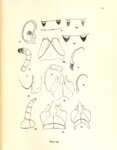
Show 29 both sexes, which and on the third leg, there is a conical process present on the prefemur of is lacking in the American Genera .. The first two pairs of legs seem more crassate than the other legs. Clypeal foveolae 2 + 2. Male without tarsal pads. The coxa of anterior gonopods broad and slightly produced distad, the telopodite slender, club-shaped and more or less straight; the ventral plate V-shaped, with arms arow, ex ceeded by the coxa. The posterior gonopods blade-like, simple and compact, with an oblique basal portion. The vulva is bean-shaped in general. Generotype: Basosolus philippinus N. Sp. 36. Banosolus Figs. This species is reddish in The prozonites usually color, more or that the trunk appears annulate. less but philippi nus N. Sp. 81-86 some specimens have faded to yellowish while the metazonites show metallic dusky Head, collum, anal scutum and valves and red in alcohol. brightness, so reddish, the antennae legs flavous. smooth, with a median sulcus distinct over vertex and clypeal region but absent from frontal region. Antennae long, attaining the third segment; the second joint the longest; only the distal two joints pilose; each article widening distad; sensory cones 4 in number; eyes rounded triangular in shape, number of ocelli from 39 in 6 rows to 44 in 7 rows. Collum smooth, anterior border margined laterally, the lower end not very acute. (Fig. 85). The second tergite not produced below the level of the collum on each side; oblique striae on the sides while transverse striae are present across the dorsum of the prozonite; longitudinal striae on the sides of the metazonites but absent from the dorsum. Other tergites with trans verse sulci distinct. Repugnatorial pores near the suture. No scobina. Transverse striae present on prozonites, those becoming oblique below the level of pores. No markings on dor sum of the metazonites but longitudinal striae below the pores present. The collum the longest, the second plate the shortest, other tergites the broadest, the cauda the narrowest. Anal scutum smooth, a transverse furrow in front of the cauda, which does not exceed the valves. (Fig. 106). Legs slender; singly spined; without tarsal pads in the male; the two anterior ones are enlarged in both sexes; prefemur of the third legs with a process. (Fig. 82). The gonopods and vulva are as shown in Figures 81, 84, and 86. Number of body segments 62 to 64. Measurements: total length, 2 males from 113 to 122 mm.; 12 females from 117 to 165 mm.; length of head, males from 5 to 6 mm., females from 6 to 8 mm.; breadth of head, males from 10 to 11 mm., females from 11 to 12 mm.; length of collum, males from 4 to 4.5 mm., females from 4 to 6 mm.; breadth of the collum, males from 11 to 12 mm., females from 12 to 15 mm.; length of the second plate, males from 2 to 2.5 mm., females from 2 to 3 mm.; breadth of the second plate, males from 11 to 12 mm., females from 12 to 15 mm.; length of the cauda, males from 3.5 to 4 mm., females from 3.5 to 6 mm.; breadth of the cauda, males from 10 to 11 mm., females from 11 to 13 mm.; length of antennae, males from 7 to 7.5 mm., females from 7 to 9.5 mm.; length of the first pair of legs, males 6 mm., females from 5 to 8 mm. Locality: 2 males and 11 females from Los Banos (Baker, no date), 1 female from Samar. Types: The male types seem to be not fully mature. 1 male holotype (P.I. No. 159), 1 male paratype (P.I. No. 149), 1 female allotype (P.I. No. 144), 11 female paratypes (P.I. Nos. 138, 152, 153-158, 144-148), all in Dr. Chamberlin's collection, Univeraity of Utah. Head 3. One family is found in the Superfamily Trigoniuloidei Philippines. Attems 1909 |