| OCR Text |
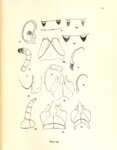
Show !l' 23 23. mindanaonus N. Spa Figs. 78-80 Dorsum including keels, blackish brown, no color pattern on dorsum such as those of the foregoing four species. Antennae, legs and sternites yellowish brown. Head coarsely granular, the vertigial sulcus deep. Antennae short and thick. Collum subequal to the head, somewhat convex, the lateral part bowed and pointed, densely granular. Along the anterior margin one row of large tubercles, behind this, other rows of tubercles are large and subequal in size, all very prominent. Prozonites very fine granular. Metazonites coarsely granular, with three transverse rows of tubercles, these all very prominent, large and subequal in size. So that in general appearance the dorsum more coarse ly tubercular than that of the foregoing species. Dorsum slightly arched, the anterior corner of the keel right angled but slightly bowed caudad. The lateral margin strongly 1 to 3 notched, due to the projecting tubercles. The re pugnatorial pores situated laterally, together with the ring, only a little larger than the tuber cles. Platyrhacus (Fig. 80). Sternite finely granular. margins parallel. Posterior margin rounded. Anal scale obtuse, with two large setigerous warts. (Fig. 78). Gonopods rather short, the principal branch of telopodite slender; slightly curved, the ac cessory branch of telopodite stouter, also a little curved, both not very long and subequal in Size, in this distinctly different from the gonopods of the other species. (Fig. 79). Locality: Mindanao (C. F. Baker). Type: I have examined three specimens, one male holotype (P.I. No. 36), one paratype (P.I. No. 35), one female allotype (P.I. No. 37), all in Dr. Chamberlin's collection at the Uni versity of Utah. Their measurements are given below: Total length, males 82 to 84 mm., females 84 mm.; length of head, 5 mm.; width of head, 8 mm.; length of collum, about 5 mm.; width of collum a little over 8 mm.; length of second plate, 4 mm.; width of second plate, 12 mm.; length of py gidium 4 mm.; width of pygidium, 4 mm.; length of antennae 7 to 8 mm.; the length of first pair of legs, 7 mm. 24. Platyrhacus bifidus Takalruwa 1942 Trans. Nat. Hist. Soc. of Formosa Vol. XXXII, No. 231, pp. 361, 365. Locality: Atong Atong, Philippines. 2. Order Spirobolida Chamberlin 1943 Cauda with lateral Key la. to Superfamilies, tile Philippine Islands posterior gonopods are entirely independent of one another, with no trace of a ster nite; a special mechanism with large vesicles in the coxae is not present; the tracheal stalks lie in the same axis as the gonopods; anterior gonopods have frequently flexibly The attached tracheal stalks. lb. Families and Genera Found in The • . . . . • of the . • . . . . . . . united . • . • • . . . • . . . • the sternite and . . . • • . . . . • • .. are 2 the by posterior gonopods membrane; begins with a vesicle into which the prostate duct discharges; or there are two vesicles connected together, into first of which the prostate duct discharges while in the second the seminal duct begins; the tracheal stalks are flexibly attached and lie in a direction oblique to the axis of the gonopods; the remainder of the tracheal stalks of the anterior gonopods are completely fused with the sternites 3 Superfamily Trigoniuloidei. 4 Family Trigoniulidae The collum somewhat acute and not exceeded below by the second tergite; the posterior gonopods of the male having a separate basal segment set off by a definite coxae a seminal duct .... 2a. . . . . • . . • . . . • . . . . • . . . . . . . . . . . . . . • . . . . • . . . . • • . . . . . . . . . . • . • • . . . • . . . • . . . • . . . • . . .. 4 |