| OCR Text |
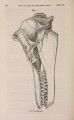
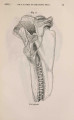
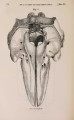
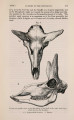
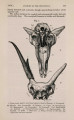
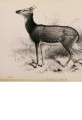
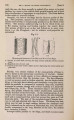
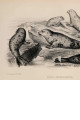
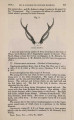
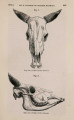
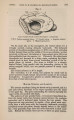
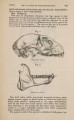
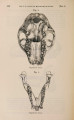
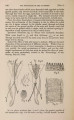
Show 1870.] DR. J. MURIE ON SAIGA TARTARICA. 497 excess of this number has occurred as a malformation. The fossil forms, Sivatherium giganteum and others, it is true, may be cited as an exception, as it unquestionably bore two postfrontal palmated antlers, likewise two infrafrontal or supraorbital horns with cores. Again, among the Antelopes the genus Tetracerus is the only living representative normally carrying four well-pronounced and separate hollow horns. But neither in Tetracerus nor Sivatherium do the two supernumerary horns occupy the position assigned by Pallas to the extra ones of Saiga. With the limitation above mentioned the Antilopine, like the Cervine, group present no examples deviating from the common rule of two horns. It is, I believe, alone the Ovine family of the Bovidee which are subject to great variation as respects the number of horns ; and hence among sheep one, two, or as many as six postfrontal horns are not unfrequently met with. Nay, more, there are well-defined breeds of four-horned Sheep wherein two horns are erect and not unlike those of Saiga, mayhap less annulated ; whilst the second pair are broader, flat, and down and inwardly curved. In this respect, therefore, and in the semitransparency of the corneous texture, Saiga tartarica gives indications of family relationship rather with Sheep than with Deer, Antelopes, Goats, or Oxen. Concerning the structure of the core supporting the horns, this, on being cut into sections, longitudinal, transverse, and tangential, was found to consist of osseous substance neither very cellular nor very solid*. Interiorly throughout almost the entire length of the core were minute parallel and partially interweaving tubuli or pores. These were of greatest diameter towards the base; but it was not ascertained whether they communicated with the frontal sinuses, though from appearances I presume they did so. The external and more solid part of the core is finely grooved. Between the bony horn-core of Antelopes, Sheep, and Goats, that of Saiga may be placed as intermediate, though as regards textural fineness it agrees most with the first mentioned. Colonel Smith's opinion, endorsed by Dr. Gray and opposed to that of M . Geoffroy St.-Hilaire, Cuvier, Latreille, aud others, is that Antilope, Caqjra, and Ovis assimilate as regards core horn-structure, but differ from the Bovidee in the cancellated tissue being of a closer consistence. The nature of the hairy coat and the manner in which it is annually shed are pertinent as regards affinities. First, it is well known the animal assumes a summer and a winter fleece; that is to say, a periodical shedding takes place. Now this changing of the Saiga's coat occurs differently from what is witnessed in Deer and Antelopes, where replacement proceeds hair by hair, so that no sudden alteration is observed. In Sheep, as is notori- * The animals examined by me having been disposed of for skeletons, I had no permission to cut into their horns or skull; but through the kindness of Mr. Bartlett an odd horn in his possession was put at m y disposal, and sliced as above stated. |