| OCR Text |
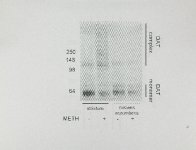
Show 42 highest molecular weight regions of the western blots. Further, OAT complexes present at 7 d also have a much higher molecular weight than those observed 24 h following METH-treatment. There are a number of possible explanations for these For instance, the lower molecular weight OAT phenomena. complexes present at 24 h may be preferentially degraded such that the higher molecular weight OAT complexes predominate at 48 - 72 h, and at 7 d. Alternatively, the lower molecular weight OAT complexes present at 24 h may continue to increase in molecular weight observed at 48 - to the create high molecular weight OAT complexes Noteworthy, OAT monomer immunoreactivity 72 hand 7 d. levels do not change significantly between 24 - 72 h, suggesting that alterations in OAT complex immunoreactivity may be due primarily to OAT protein that has already formed complexes. Previous studies have suggested that OAT complex formation occurs through an oxidative mechanism (Baucum et aI., 2004; Hadlock et aI., 2009). mechanism also it is reasonable contributes to the Therefore, increase to in postulate that molecular an weight oxidative of OAT complexes seen at 48 h, 72 h, and 7 d following METH-treatment. This prolonged oxidative stress may be caused induced by numerous mechanisms involved in METH neurotoxicity that cause oxidative stress including, but not limited to, microglial activation, astrocytic activation, and excitotoxicity (for review, see Krasnova and Cadet, 2009; Quinton and Yamamoto, 2006). Previous studies have suggested that OAT complex formation may be associated with persistent dopaminergic deficits (Baucum et aI., 2004; Hadlock et aI., 2009). This is supported by evidence that prevention of METH-induced |