| OCR Text |
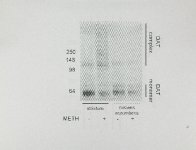
Show 35 Cadet, 2009), astrocytic/microglial activation (LaVoie et aI., 2004; Thomas et aI., 2004; O'Caliaghan and Miller, 1994), OAT complex formation (Baucum et aI., 2004; Hadlock et aI., 2009), and alterations in vesicular monoamine transporter 2 (VMAT2) function (Brown et aI., 2000; yerman and Yamamoto, 2007; Guillot at However, the relationship among these factors has not been aI., 2008). elucidated fully. Accordingly, the purpose of this study was to investigate possible associations among three of these phenomena, in particular: METH induced OAT complex formation, alterations in VMAT2 immunoreactivity, and astrocytic activation. Results revealed that alterations in VMAT2 and OAT in increases immunoreactivity precede glial fibrillary acidic protein (GFAP) immunoreactivity, a marker of astrocytic activation and neuronal damage (Eng et aI., 2000). Further, high molecular weight DAT complexes distinct from those apparent 24 h after METH treatment were present 48 METH-treatment. phenomena. 02 Finally, - 72 h, and also 7 dafter receptor-activation contributes to each of these These studies advance underlying the persistent alterations our in understanding of the mechanisms dopaminergic neurons consequent to high-dose MEliH treatment. Methods Animals. Male Sprague-Dawley rats (290-400 g; Charles River Laboratories, Inc., Raleigh, NC) were maintained under controlled lighting and temperature with constant access to food and water. four animals maintained at per cage warmer during the temperatures Rats were housed three experiments. METH-treated to ensure METH-induced rats were hyperthermia. |