| OCR Text |
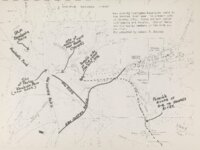
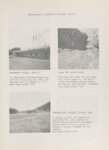
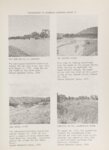
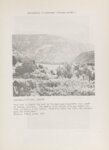
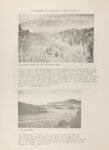
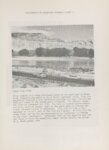
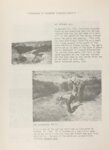
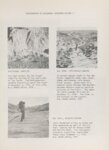
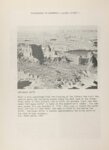
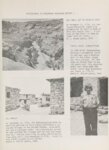
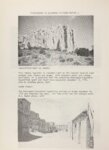
Show RESEARCH AND From San and east to INTERPRETATION Angel the its head w. Spaniards the fol lowed the sma I I valley one L. Rusho mf Ie south top proper, topping present Temple Tank Reservoir. At that point they faced a rol ling land of low relief, punctuated by occasional cinder cones and ridges. They headed east-southeast for two leagues, reaching Lang's Run, but finding no water, they turned north east. This swing took them through a group of cinder cones known locally as Seven Knol Is, then down a rough steep slope into the south end of Black Canyon. They reached the canyon floor just north of the present Black Canyon on out mesa near the Reservoir. Sti I I without water they crossed'Black Canyon, heading east directly Just imposing beyond this an I about isolated smal mesa 200 50 yards wide, and they passed yards long crowned with a flat lava surface that dips to the north. In his 1927 study Herbert E. Bolton said it was shaped like a hayrick, or large haystack. It was on this mesa that the five Indians hid from the approaching Spaniards, then spoke to them as the expedition passed beneath. beneath For the cinder cone known as Hat Knol I. piece of cloth the timid Indians were persuaded to conduct the expedition to water, which was found about five mi les to the southeast in a short This canyon, an upper canyon which we have cal led Bobcat Canyon. headstream of Clayhole Wash, is about two mi les long, leading north from Bobcat Reservoir through a long lava ridge. The camp named San Samuel was the made at the of mouth nearest several pools of water canyon undoubtedly a that had collected on the bedrock streambed. This camp, located two miles south of Swapp Reservoir, was occupied by the Spaniards for the nights of October 18 and 19. RESEARCH METHODS required careful consideration of directions, distances, Not only is the topography confusing, but the diary indicates landmarks. that is in error. an initial direction from San Angel By reference to the earlier Bolton study this error was quicky found and the route properly adjusted. When this was done the remainder of the route fell easi Iy into place. After determining that the site of San Samuel was at the mouth of Bobcat Canyon, we learned that the site is also known to local ranchers as "Copoer's Pockets," which was the name Bolton applied to the site. The route for'the This section and 18, 1776, could not be fol lowed closely for lack of roads, but fol lowed for short distances at Lang's Run, Black Canyon, Bolton's Hayrick, and Bobcat Canyon. Researchers were W. L. Rusho, C. Gregory Crampton, and Jane Rusho who made the study on June 17, 1975 day it of October was Joseph C. Bolander, employee at Pipe Spring and old-time region, ran sheep in this area in 1926 and 1927. He advised in Cooper's Pockets are found on lava bedrock of the canyon. -151- . a resident of the that the pools short distance from the mouth |