| OCR Text |
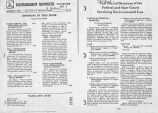
Show 422 455 FEDERAL REPORTER, 2d SERIES There can be no question that the hearings on PA'SNY's application, ordered pursuant to Section 308 of the Federal Power Act, 16 U.S.C. § 825g, and Section 1.20 of the Commission's rules, 18 C.F.R. § 1.20 (January 1, 1971), constitute an existing agency review process. [6, 7] Though we conclude that the Commission was in violation of NEPA by conducting hearings prior to the preparation by its staff of its own impact statement,24 we are of the view that it did not seek improperly the advice of other agencies on the basis of PASNY's application. Section 102(2) (C) compels the agency to seek this advice before preparing its statement. Section 102(1), however, directs that "to the fullest extent possible" regulations should be interpreted and administered in accordance with the policies of NEPA. In. this regard, it would be instructive for the Commission to consult the rules of the Atomic Energy Commission, 36 Fed.Reg. 18071 (Sept. 9, 1971), promulgated after the decision in Calvert Cliffs' charged the AEC with a "crabbed interpretation of NEPA [which made] a mockery of the Act." 449 F.2d at 1117. The Atomic Energy Commission, although it still requires an applicant to submit its environmental report, prepares a draft report of its own in advance of seeking the advice of other federal agencies. Then, on the basis of comments received from these agencies and all interested parties, it prepares its final detailed statement, which official monthly bulletin the Council published the following notice of the PASNY report: Applicant's drafts. (These are not official FPC drafts. They will be followed by staff-prepared draft statements.) . . . 24. In its brief to this Court, the Commission argued that it would be in contravention of Section 8(a) of the Administrative Procedure Act, 5 U.S.C. § 557, which prohibits Commission participation in the decision-making process until the record is completely developed, if it were required to adopt a position in an environmental impact statement. Certainly no one has suggested that the detailed state-is offered in evidence at a contested hearing. [8] In light of our foregoing discussion, we must consider the most efficient procedure for ensuring that the policies of NEPA are implemented in Commis-sion proceedings on the Gilboa-Leeds line. For the reasons we have set forth, we deem it essential that the Commission's staff should prepare a detailed statement before the Presiding Examiner issues his initial decision. Moreover, the interveners must have a reasonable opportunity to comment on the statement. But, since the statement may well go to waste unless it is subject to the full scrutiny of the hearing process, we also believe that the intervenors must be given the opportunity to cross-examine both PASNY and Commission witnesses in light of the statement. "Often individuals and groups can contribute data and insights beyond the expertise of the agency involved." CEQ Report, 1 Environmental L.Rep. at 50059. We leave to the Commission to determine the most efficient procedure for meeting this mandate. [9] Fully recognizing that delay unfortunately is incident to our mandate and PASNY's claim that the Blenheim- Gilboa Project is a vitally needed power facility, we can only add our voice to that of the District of Columbia Circuit in Calvert Cliffs': Delay is a concomitant of the implementation of the procedures prescribed by NEPA, and the spectre ment prepared before the hearings must be prepared by the Commission members. I t is sufficient for the purposes of NEPA if the statement is prepared by the Commission's staff on the basis of the staff's investigations. Counsel for the Commission conceded at oral argument that this procedure would not violate the APA. See also Section 6(d) of the Guidelines of the Council on Environmental Quality: Where an agency follows a practice of declining to favor an alternative until public hearings have been held on a proposed action, a draft environmental statement may be prepared and circulated indicating that two or more alternatives are under consideration. |