| OCR Text |
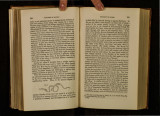
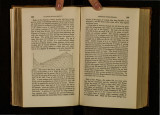
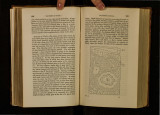
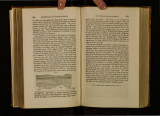
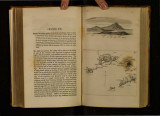
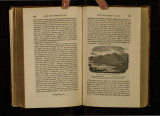
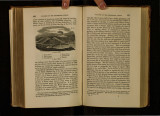
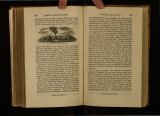
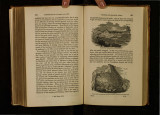
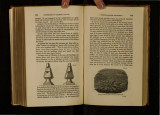
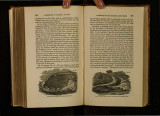
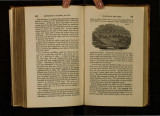
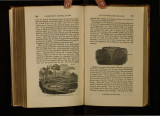
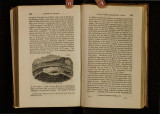
Show 422\ • - - EAnTnQtJAKE IN OALADlUA, A,D, 1783. ' sents one by no means remarkable for its dimen&ions, which :temained open by the side of a small pass over the hill of St. Angelo, near Soriano. The small river Mesima is seen in the foreground. · In the vicinity of Seminara, a lake was suddenly formed by the opening of a great chasm, from the bottom of which water issued. This lake was called Lago del Tolfilo. It extended ~380 palms in length, by 1~50 in breadth, and '70 in depth. The inhabitants, dreading the miasma of this stagnant pool, endeavoured, at great cost, to drain it by canals, but without success, as it was fed by springs issuing from the bottom of the deep chasm. A small circular subsidence occurred not far from Polistena, of which a representation is given in the annexed cut. Circular pond near l'olilltna, i ll Calabria, cauwl by tile ea•·tlaqua/ee lr1 1783. Sir· W, Hamilton was shown several deep fissures in the vicinity of Mileto, which, although not one of them was above a foot in breadth, had opened so wide during the earthquake as to swallow up an ox and near one hundred goats. 'rhe Academicians also found, on their return through districts which they had passed at the .commencement of their t?ur, that man.~ rents had in that short mterval gradually closed m, so that theu width had diminished several feet, and the opposite walls had sometimes nearly met. It is natural that this should happen in argillaceous strata, while in more solid rocks we ma1 expect that fissures will remain open for ages. Should tlus be 'ascertained to be a general fact in countries convulsed l'ORMATIO~ OF LAKES BY J:ANDSLIPS. 423 by earthquakes, it would afford a satisfactory explanation of a common phenomenon in mineral veins. Such veins often retain their full size so long as the rocks consist of limesto~ e, ~ranit~, or other indurated materials; but they contract their dimensiOns, become m~re threads, or are even entirely cut off, where masses o~ an argillaceous nature are interposed. If we suppose the fillmg up of fissures with metallic and other ~ngred}ents to be a proce~s requiring ages for its completion, it 1s obvwus that the opposite walls of rents, where strata consist of yielding materials, must collapse or approach very near to each other before sufficient time is allowed for the accretion of a large quantity of veinstone. It is stated by Grimaldi that the thermal waters of St. Euphemia, in Terra di Amato, which first burst out during the earthquake of 1638, acquired, in February 1783, an auO'mcn. tati.on ~oth in quanti~y and degree of heat. 'l'his fact a;pears to md1eate a conncx10n between the heat of the interior and the fissures caused by the Calabrian earthquakes, notwithstanding the absence of volcanic rocks either ancient or modern in that district. The violence of the movement of the ground upwards was singularly illustrated by what the Academicians call the "sbalzo," or bounding into the air, to the height of several yards, of masses slightly adhering to the surface. In some towns a great part of the pavement-stones were thrown up, and found lying with their lower sides uppermost. In these cases we must suppose that they were propelled upwards by the momentum which they had acquired, and that the adhesion of one end of the mass being greater than that of the other, a rotatory motion had been communicated to them. When the stone was projected to a sufficient height to perform somewhat more than a quarter of a revolution in the air, it pitched down on its edge and fell with its lower side uppermost. · The next class of effects to be considered, are those more immediately connected with the formation of valleys, in which the action of water was often combined with that of the earthquake. The country agitated was composed, as we before stated, chiefly of argillaceous strata, intersected by deep narrow ·Valleys, sometimes from five to six hundred feet deep.. As the |